Skip to content
I get this question almost every single week. Someone walks into my office, or calls me on the phone, and they ask: “How much of my salary can I spend on a mortgage?”
It’s the right question to ask. It really is. Because this is probably the biggest financial commitment you’ll ever make, and you want to make sure you’re doing it the right way.
But here’s the thing—the answer you get from your lender, and the answer you should actually live by? Those can be two very different numbers. And that’s where a lot of people get into trouble.
The Lender’s Number vs. Your Number
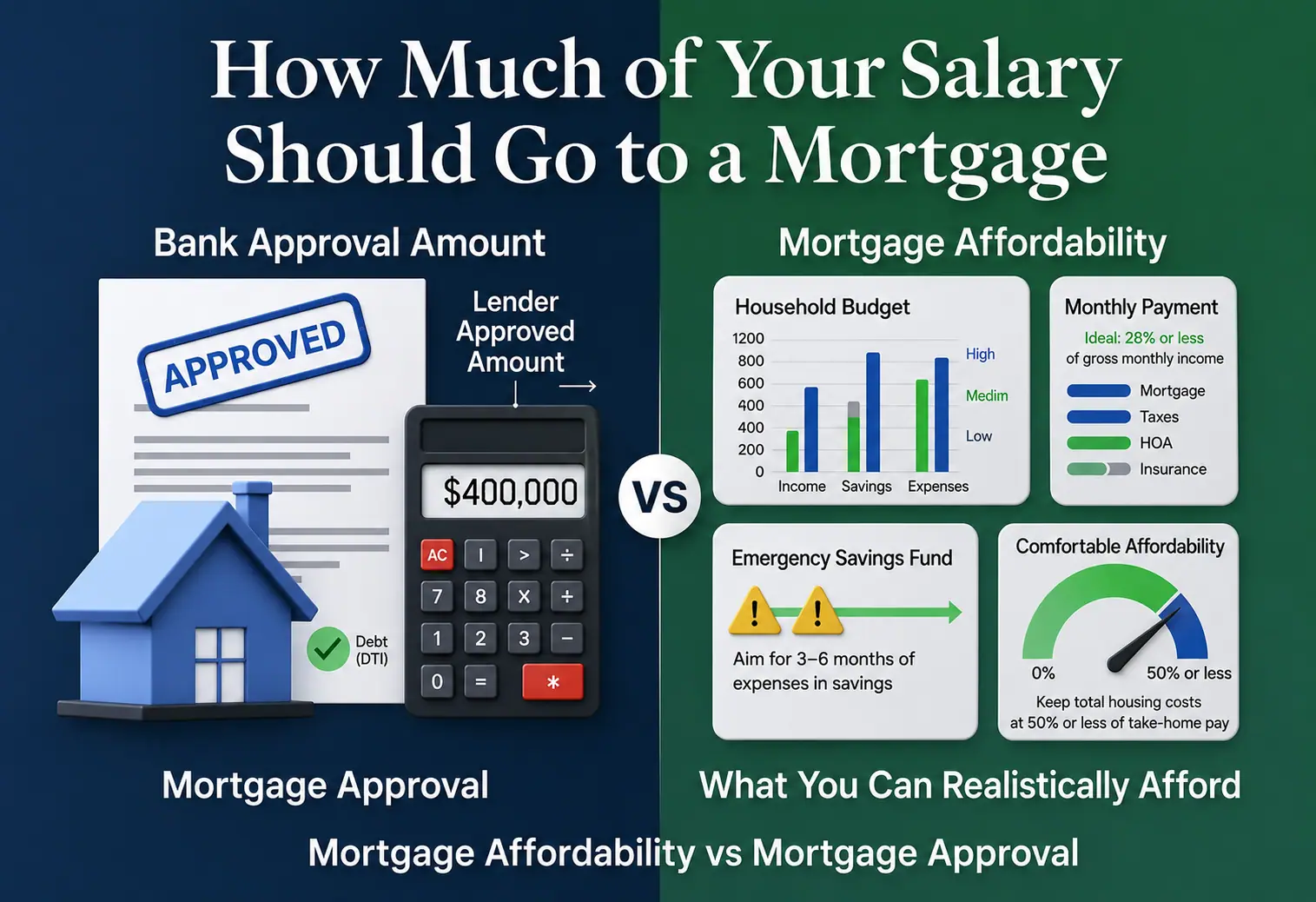
Let me start with the official answer you’ll hear. Most lenders—and this is what the lending industry has settled on—will approve you for a mortgage payment that takes up about 28% of your gross monthly income. Add in all your other debts, like car payments and credit card minimums, and that number goes up to about 43%.
So if you make $5,000 a month gross, the lender says you can afford about $1,400 in mortgage payments. That’s the magic number they use to decide if you qualify.
Here’s where I need to be straight with you: just because a lender will approve you for that amount doesn’t mean you should borrow it.
I see this all the time. People get pre-approved for the maximum amount and they think that means they can afford it. They feel excited, they look for homes right at their approval number, and then they close on a house that actually stresses them out every single month. And by that point, it’s too late.
The Borrower Who Learned This Lesson the Hard Way
I had a client named Jennifer about five years ago. She was a teacher making about $62,000 a year. She’d saved a good down payment, and she was ready to buy. The lender pre-approved her for $385,000, which felt amazing to her. Finally, she could get a house of her own.
The mortgage payment on that home came to about $2,100 a month. That was right at the lender’s number—28% of her gross income. She took the approval and found a house she loved.
Fast forward two years. Jennifer called me, and she was stressed out of her mind. Her car had needed transmission work. Her water heater broke. Her property taxes went up. And suddenly that $2,100 mortgage payment, which looked fine on paper, was eating up almost all of her take-home pay. She had no room for emergencies. She was living paycheck to paycheck in her own home.
“I should have bought something cheaper,” she told me. She was right.
Let’s Talk About What the Numbers Actually Mean
Okay, so the lender says 28%. But we need to talk about what that actually includes and what it doesn’t.
That 28% of your gross income covers your mortgage payment—principal, interest, taxes, and insurance. That’s usually called your PITI. The “P” is principal and interest. The “T” is property taxes. The “I” is insurance.
But here’s where people get tripped up. Your mortgage payment isn’t just the principal and interest part. It also includes property taxes and homeowners insurance. For a lot of people, those two things together can be 25% or 30% of your total monthly payment. So the payment your lender gives you is already accounting for this.
But what it doesn’t account for? Everything else. HOA fees. Utilities. Maintenance. Repairs. Property management if you’re renting part of your property out. These things add up fast.
The Difference Between Gross and Net Income
This is one of the biggest misconceptions I run into. When the lender talks about “28% of your income,” they mean your gross income. That’s your salary before taxes, before your 401(k), before health insurance, before all the stuff that gets taken out of your paycheck.
But the money you actually have to spend? That’s your net income. The money that hits your bank account after everything gets taken out.
Let me give you a real example. Say you make $60,000 a year. That’s $5,000 gross a month. But after taxes, insurance, and retirement contributions, your actual take-home might be closer to $3,500 or $3,600 a month.
The lender calculates 28% of that $5,000, which is $1,400. But that $1,400 mortgage payment is coming out of your $3,600 net income. That’s 39% of what you actually have to spend. That’s a massive difference.
So What’s the Real Number You Should Aim For?
Based on what I’ve seen work in real life, not just in lending guidelines, here’s what percentage of income should actually go to a mortgage:
Start With Your Net Income
Figure out what you actually take home each month. Not your gross salary—your actual, real take-home after taxes and everything else. That’s the number that matters because that’s the money you actually have to work with.
Aim for 20-25% of Your Net Income
I’ve had the best luck with borrowers who keep their mortgage payment to somewhere between 20% and 25% of their net take-home income. That might sound low compared to what a lender will approve you for. But trust me, it’s not.
Here’s why. If your mortgage takes up 20-25% of your actual income, you still have 75-80% left for everything else. Utilities. Car payments. Insurance. Food. Childcare. Unexpected emergencies. Savings. Retirement.
When you’re spending 40% or 45% of your income on a mortgage, like the lenders will let you do? You don’t have room for anything else.
Let Me Show You the Real Numbers
Let’s say you make $75,000 a year gross. After taxes and benefits, your net take-home is about $55,000 a year, or roughly $4,600 a month.
At 28% of gross (what the lender will approve), you get a mortgage payment of about $1,750.
But 28% of your gross $75,000 is actually eating up 38% of your net $55,000 take-home income. That’s almost 40% of the money you actually get.
If you instead aim for 20-25% of your net income, you’re looking at a mortgage payment between $920 and $1,150. That home price would be significantly lower. But you’d actually be able to afford it. You’d have money left over for life.
But Wait—What About My Other Debts?
This is crucial. The lender looks at all your debts together—your mortgage, your car payment, your credit cards, your student loans, everything. They say all of that combined shouldn’t exceed 43% of your gross income.
So if you’ve got significant debt already, you need to account for that.
I’ve had borrowers who come in making great money, but they’ve got $400 a month in car payments, $200 in student loans, and $300 in credit card minimums. That’s $900 right there before we even talk about a mortgage.
So when a lender says you can afford a $2,000 mortgage payment because you’re at 43% debt-to-income, they’re including all that stuff. You’d be at a combined debt payment of $2,900 a month.
Most buyers don’t realize this until they’re halfway through the mortgage approval process, and suddenly they can’t afford the house they thought they could afford because their debt load was eating up so much of their capacity.
Here’s Where People Actually Get Into Trouble
After all these years doing this, I can spot the people who are about to make a mistake. They usually come in with a specific number in their head. “I can afford $2,000 a month,” they say. Or “I want to buy a $400,000 house.”
And sometimes when we do the math, that number makes sense. The lender says yes. Everyone’s happy.
But then I ask them: “What happens if you lose your job? What happens if your hours get cut? What happens if an emergency comes up?”
A lot of times, they don’t have a good answer.
You Need a Cushion
This is non-negotiable in my mind. Your mortgage payment should be low enough that you can still make it if something goes wrong. Not just barely make it. Actually make it comfortably.
I’ve had borrowers who were at the absolute maximum the lender would approve, and then one of them lost a job. They didn’t have family to help them. They didn’t have savings. They ended up in foreclosure. I’ve seen this happen multiple times.
The lender doesn’t care about your story. They care about getting paid. If you can’t pay, they’ll take the house. It’s that simple.
Fixed Costs Plus Everything Else
Here’s something that helped one of my borrowers—a guy named Marcus—really get his head on straight about this.
He added up all his fixed monthly costs. His mortgage. His car payment. His insurance. His minimum debt payments. Everything that had to go out every single month. That was about $2,400 for him.
Then he said: “Okay, that’s my absolute floor. I need to make enough money every month to hit that number.”
Above that $2,400, he had expenses for everything else—groceries, utilities, gas, the occasional dinner out. But at least he knew his minimum threshold. If anything happened, he knew exactly what he had to cover.
When you buy a house based only on the lender’s approval number, you don’t have that clarity. You’re just hoping things work out.
What About Income That Changes?
If you’re self-employed, if you’re on commission, if your job has irregular hours, we need to talk about this differently.
The lender will look at your average income over the past two years. But that’s the lender’s calculation. In your real life, you might know that some years are way better than others.
I see this all the time with real estate agents, salespeople, and contractors. They have great years and lean years. The lender takes an average, but that doesn’t mean you can count on that income every single month.
If that’s your situation, you need to be even more conservative with your number. If your average income over two years is $80,000, but you know some years it’s $60,000? You should probably base your mortgage decision on the $60,000 number, not the average.
This is the kind of thing that keeps me up at night, honestly. Because I’ll approve someone for a mortgage based on numbers that look good, but then their income drops and they’re in real trouble.
Don’t Forget About Property Taxes and Insurance
Here’s where most people mess up their calculations. They focus on the principal and interest part of their payment, and they forget that property taxes and insurance are included too.
If you’re buying in a high-tax area, those taxes can be a huge chunk of your payment. I’ve had clients in certain parts of the country where property taxes are 30% or 40% of their total mortgage payment.
Insurance rates are going up too. Homeowners insurance has gotten expensive in the last few years. And if you’re putting down less than 20%, you’ll also have PMI, private mortgage insurance, which is another $100-300 a month depending on the situation.
So when you’re thinking about “how much can I afford,” remember that the interest and principal part is usually only about half or 60% of your actual payment.
The Honest Conversation About Lifestyle
Here’s the real talk that nobody likes to have. Just because you can afford a certain mortgage payment doesn’t mean you can afford the lifestyle that comes with the house.
I had a borrower—let’s call her Amanda—who was approved for a $400,000 house. She could technically afford it based on the numbers. But when we talked about it more, she realized she wouldn’t be able to save for retirement, wouldn’t be able to take vacations, and would be stressed every single month.
She ended up buying a house for $280,000 instead. The mortgage payment was lower, and suddenly she had breathing room. She could save. She could enjoy her home instead of being stressed about affording it.
“I’m so much happier,” she told me about a year in. “I didn’t realize how much stress I was under trying to figure out how to make that bigger payment work.”
That’s the thing nobody talks about. Your mortgage isn’t just a number. It’s your life. If that payment is consuming your life, you’ve chosen the wrong house.
What’s Actually a Safe Number?
Okay, let me cut through all of this and give you my actual recommendation based on my experience.
Your total housing payment—mortgage, taxes, insurance, HOA if you have it—should be no more than 25% of your gross monthly income. Not 28%. Not 30%. 25%.
And if you include all your debts—your mortgage, your car payments, your credit cards, your student loans, everything—that should stay under 35%, not 43%.
If you hit those numbers, you’re going to have room to breathe. You’re going to be able to handle emergencies. You’re going to be able to save. You’re going to be able to actually enjoy the home you’re buying.
Does that mean you might buy a house that’s less expensive than what the lender will approve? Absolutely. Does that mean you’re not taking full advantage of “what you can afford”? Yes. And that’s fine. That’s actually the smart choice.
Before You Make Your Decision
Before you give up on the idea of homeownership because you think you can’t afford what you want, sit down and do the actual math.
Figure out your actual net take-home income. Don’t be shy about it—be honest. Add up all your actual monthly expenses. Add up all your debt. Then run the numbers on our mortgage calculator to see what a payment would actually do to your budget.
Get pre-approved by a lender—that’s important—but don’t let that approval number be your budget. That number is just what the lender thinks is acceptable risk. It’s not a recommendation for how much you should spend.
Talk to someone who’s actually going to listen to your whole situation. Not just a lender who wants to make a sale, but someone who actually cares about whether you’re making the right decision.
Conclusion :
Lenders will approve you for about 28% of your gross income toward a mortgage. But that doesn’t mean you should borrow that much.
In real life, in actual practice, I’ve seen the people who are happiest with their homes are the ones spending 20-25% of their net income on a mortgage payment. They have money left over. They can save. They can handle problems.
Is the house you can afford maybe smaller than the house you could technically borrow money to buy? Maybe. But you’re going to actually enjoy it. You’re not going to be stressed every single month. Your life isn’t going to revolve around your mortgage payment.
That’s worth a lot more than a bigger house and constant financial stress.
Buy the home you can truly afford, not the maximum the lender will approve. Your future self will thank you for it.