 Skip to content
Construction Draws
Construction Loan Draw Schedule:
How Draws Work
How a construction loan is paid out in stages, what an illustrative draw schedule looks like, why you pay interest only on what has been drawn, and how to keep a project funded from start to finish.
- Paid Out
- In Drawsas work is completed
- Interest
- On Drawnnot the full loan
- Inspection
- 3rd Partybefore each draw
- Term
- 12-24 moground-up construction
- Interest Reserve
- Availablecase by case
- Borrower
- EntityLLC or corporation
Draw counts and amounts are set to the scope of each project. Terms subject to lender approval and program guidelines.
How a Draw Schedule Works
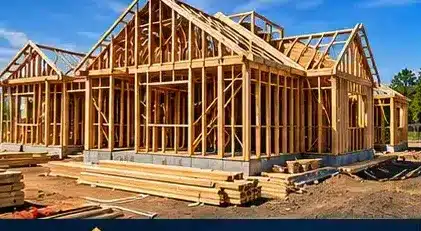
A construction loan is not paid out in one lump sum. The money is released in stages as the work is finished. You build, the work is verified, and the next portion of the loan is released. That keeps the lender funding real progress and keeps you from paying interest on money you have not used yet.
Interest is charged only on the funds drawn at the time, not on the full commitment. In the first months of a build, when only the lot and early work are funded, the interest is a fraction of what it will be when the loan is fully drawn.
Before each draw, a third-party inspection service verifies the work that was completed. A renovation loan works the same way with fewer draws, set to the scope of work.
Illustrative draw schedule
| 1. Site work and foundation | About 15% |
| 2. Framing and roof | About 20% |
| 3. Rough mechanical, electrical, plumbing | About 20% |
| 4. Insulation, drywall, exterior | About 15% |
| 5. Finishes and fixtures | About 20% |
| 6. Final and completion | About 10% |
Illustrative percentages only. Your schedule is set to the project scope and the budget. It is not a quote.
Keeping Draws Smooth
Five habits that stop a project from stalling.
-
Budget line by line
A draw schedule follows your budget. The more specific the budget, the cleaner each draw request.
-
Request when the work is done
Draws pay for completed work. Ask when a stage is finished and photographed, not when it is about to start.
-
Keep your paperwork together
Invoices, contracts and permits for each stage in one place make the inspection and the release go faster.
-
Plan for the last draw
Final inspections, certificates and punch-list items often hold the last portion. Budget cash for them.
-
Watch the contingency
If a stage runs over, tell us early. A short note beats a surprise on the next request.
Frequently Asked Questions
What is a construction loan draw schedule?
A plan for releasing the loan in stages as work is completed. Each stage is tied to finished work, and funds are released after the work is verified.
How many draws will my loan have?
The number is set to the scope of your project. A ground-up build has more draws than a renovation, which is closer to a construction loan with fewer draws.
Do I pay interest on the whole loan from day one?
No. Interest is charged only on the funds drawn at the time, not the full commitment, so it rises as the loan is drawn.
Who inspects the work before a draw?
A third-party inspection service verifies the completed work before each draw is released.
Can a draw schedule include an interest reserve?
An interest reserve is available. Whether it fits your deal depends on the budget and the loan size, so we look at it case by case.
What happens if my project costs more than the budget?
Tell us as early as you can. The loan is sized on the budget you give us, so overruns usually mean more cash from you or a change to the plan.
Planning a Build?
Send us the budget and the scope. We will come back with a term sheet or a straight answer.
Prefer to send everything at once? Start the full deal application.
Loan Program Disclosures
LTC / ARV & Underwriting Disclaimer
Maximum Loan-to-Cost (LTC) and After-Repair Value (ARV) percentages shown are guidelines only and represent maximum potential leverage, not guaranteed loan terms. Actual leverage may be reduced based on the overall risk profile of the borrower, property, and project.
Factors that may result in lower LTC and/or ARV limits include, but are not limited to: rural or sparsely populated locations; declining or unstable property values identified by the appraisal or other market data; excessive housing inventory or extended marketing times; limited comparable sales; unique, specialized, or non-conforming properties; low marketability or liquidity; high renovation or construction costs relative to property value; extensive or complex rehabilitation; borrower experience; credit profile; liquidity and reserves; project feasibility; appraisal findings; title or property-condition concerns; and other geographic, market, collateral, or underwriting risks.
Loan amount, LTC, ARV, interest rate, fees, term, and other conditions are determined on a case-by-case basis and are subject to lender underwriting, appraisal, due diligence, program requirements, and final approval. Programs, guidelines, and terms are subject to change without notice. Not all borrowers or properties will qualify for maximum leverage.
Loan Amount
Loan amount is limited to the lower of the stated percentage of total project cost (LTC) or of the after-repair value (ARV). Examples on this page are hypothetical and are not a quote.
Business-Purpose Lending
VeeCasa Funding LLC makes loans for business and investment purposes only, secured by non-owner-occupied real estate, to business entities only. These are commercial loans. They are not consumer mortgages, are not intended for personal, family, or household use, and are not subject to NMLS or SAFE Act licensing. Loan programs, terms, leverage, and availability are subject to underwriting, property review, and credit approval, and may change without notice. Not a commitment to lend.
VeeCasa Funding LLC · 301B Amboy Ave, Woodbridge, NJ 07095 · (732) 314-1874
