Skip to content

Figuring out how much mortgage you can afford is the most important first step before buying a home. Borrow too little and you may miss out on the home you want. Borrow too much and you risk financial strain that can follow you for decades.
The good news is that answering “mortgage can you afford” is not guesswork. Lenders, government agencies like the Federal Housing Administration (FHA) and the Department of Veterans Affairs (VA), and tools from Fannie Mae and Freddie Mac all offer clear frameworks for calculating your safe borrowing limit.
This guide walks you through exactly how affordability is calculated, what rules lenders use, how to use tools like the Zillow Affordability Calculator, and what mistakes to avoid before applying for a loan.
What Does Mortgage Affordability Mean?
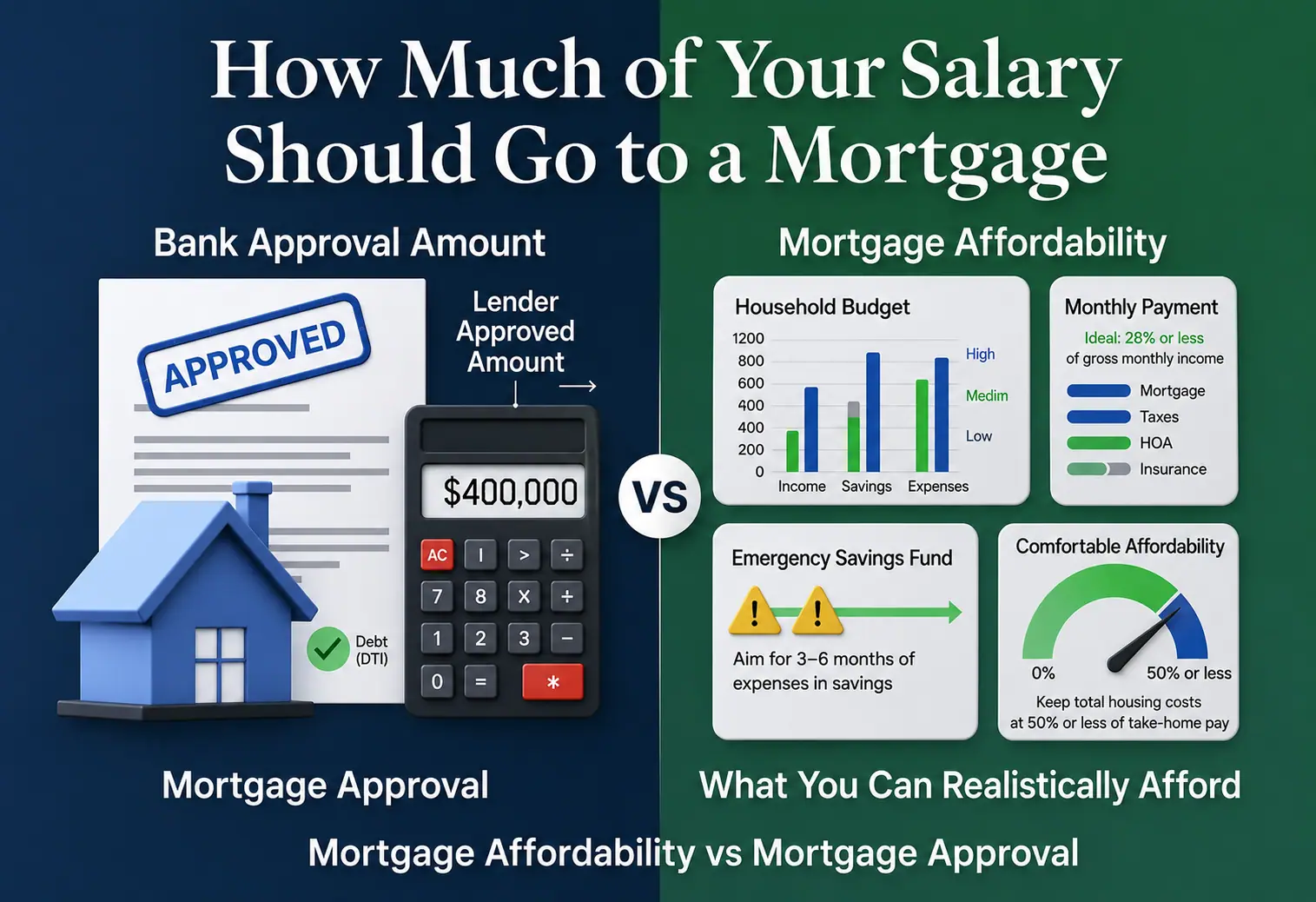
Mortgage affordability refers to the maximum home loan amount a borrower can comfortably repay based on their income, existing debts, credit profile, and monthly expenses. It is not simply how much a lender will approve — it is how much you can actually manage without stretching your financial solvency.
Lenders measure this using two core ratios: the front-end debt ratio (housing costs vs. gross income) and the back-end debt ratio (all monthly debts vs. gross income). Together, these form the basis of what is commonly called qualified mortgage standards set by the Consumer Financial Protection Bureau (CFPB).
The 28/36 Rule of Thumb Explained
The 28/36 rule is the most widely used benchmark in mortgage affordability. It works as follows:
- Front-end ratio: Your monthly housing costs (PITI — Principal, Interest, Taxes, and Insurance) should not exceed 28% of your gross monthly income.
- Back-end ratio: Your total monthly debt payments — including the mortgage, car loans, student loans, and credit card minimums — should not exceed 36% of your gross monthly income.
Practical Example Using the 28/36 Rule
Suppose your gross monthly income is $7,000:
- 28% of $7,000 = $1,960 maximum for housing (PITI mortgage bundle)
- 36% of $7,000 = $2,520 maximum for all debts combined
- If you already pay $400/month in car payments and $200 in student loans, your remaining mortgage budget is: $2,520 – $600 = $1,920/month
Note: Some lenders — particularly those offering FHA loans — allow back-end ratios up to 43% or higher for borrowers with strong compensating factors. Conventional loans backed by Fannie Mae or Freddie Mac typically follow stricter guidelines.
Key Factors That Determine How Much Mortgage You Can Afford
- Gross Monthly Income
Lenders look at your total pre-tax income from all verified sources — salary, self-employment, rental income, or investment returns. This forms the baseline for all affordability calculations.
- Monthly Debt Obligations
All recurring minimum debt payments are counted: car loans, credit cards, student loans, personal loans, and any existing mortgage payments. Lower debt means a higher borrowing capacity.
- Credit Score
Your credit score directly affects your interest rate, which affects your monthly payment, which affects how much you can borrow at a given payment level. According to FICO and major bureaus like Experian, Equifax, and TransUnion:
- 760 and above: Best rates available
- 700-759: Good rates, most programs accessible
- 620-699: Limited options; FHA loans typically require at least 580
- Below 580: Very limited; may require larger down payment or alternative programs
- Down Payment
A larger down payment reduces the loan amount, lowers the loan-to-value (LTV) ratio, and may eliminate the need for private mortgage insurance (PMI). Conventional loans often require at least 5-20% down, while FHA loans allow as low as 3.5% for qualifying borrowers.
- Interest Rate and Loan Term
Even a 0.5% difference in interest rate can significantly change your monthly payment. A 30-year loan reduces monthly payments compared to a 15-year loan, but you pay more interest over the life of the loan. Rates vary by lender, market conditions, and borrower profile.
- Property Taxes and Insurance
Your PITI mortgage bundle includes property taxes and homeowners insurance. These vary significantly by location and property type. Escrow account management by your lender typically collects these monthly as part of your mortgage payment.
How to Calculate How Much Mortgage You Can Afford: Step by Step
- Calculate your gross monthly income. Add all pre-tax income sources per month.
- Add up all monthly debt payments. Include minimum payments on every account.
- Apply the 28% front-end rule. Multiply your gross income by 0.28 to find your maximum housing payment.
- Apply the 36% back-end rule. Multiply gross income by 0.36, then subtract existing monthly debts. This is your maximum mortgage payment.
- Estimate property taxes and insurance. Contact local tax authorities or get insurance quotes. Subtract these from your maximum housing budget.
- Use an affordability calculator. Tools like the Zillow Affordability Calculator or the NerdWallet Mortgage Tool can estimate your max loan amount based on these inputs.
- Get pre-approved. Work with lenders like Rocket Mortgage, Bank of America, or Chase Home Lending to receive an official pre-approval letter that confirms your real borrowing limit.
Government Programs That Affect Mortgage Affordability
FHA Loans (Federal Housing Administration)
FHA loans are insured by the Federal Housing Administration and are designed for first-time buyers and those with lower credit scores. They allow down payments as low as 3.5% with a credit score of 580 or higher. FHA loans permit back-end ratios up to 43% — or higher with compensating factors.
VA Loans (Department of Veterans Affairs)
VA loans are available to eligible service members, veterans, and surviving spouses through the Department of Veterans Affairs. They require no down payment, no PMI, and offer competitive interest rates. The VA uses a residual income approach rather than strict debt-to-income ratios.
Fannie Mae and Freddie Mac Conventional Loans
Conventional loans sold to Fannie Mae or Freddie Mac must meet their underwriting guidelines, which typically require a debt-to-income ratio of no more than 45-50% for automated approvals, a credit score of at least 620, and private mortgage insurance if the down payment is under 20%.
USDA Loans
USDA loans are available for eligible rural and suburban homebuyers and offer zero-down-payment options. Income limits apply and vary by location. The USDA targets buyers with low to moderate discretionary income who cannot obtain conventional financing.
Mortgage Affordability by Income Level: Comparison Table
The table below shows estimated monthly mortgage budgets and approximate home purchase price ranges based on gross annual income, assuming a 20% down payment, 7% interest rate (30-year fixed), $300/month in existing debts, average property taxes and insurance, and good credit (700+ score). Actual results vary by lender, location, and borrower profile.
| Annual Income | Monthly Gross | Max Housing (28%) | Max All Debt (36%) | Est. Home Price Range |
| $40,000 | $3,333 | $933/mo | $1,200/mo | $120K-$150K |
| $60,000 | $5,000 | $1,400/mo | $1,800/mo | $180K-$220K |
| $80,000 | $6,667 | $1,867/mo | $2,400/mo | $240K-$290K |
| $100,000 | $8,333 | $2,333/mo | $3,000/mo | $300K-$360K |
| $120,000 | $10,000 | $2,800/mo | $3,600/mo | $360K-$430K |
| $150,000 | $12,500 | $3,500/mo | $4,500/mo | $440K-$530K |
Affordability Tools and Calculators
Several trusted tools can help you run through your numbers before speaking with a lender:
- Zillow Affordability Calculator: Lets you enter income, debts, down payment, and location to estimate your home price range.
- NerdWallet Mortgage Tool: Offers mortgage affordability and payment calculators with lender comparisons.
- Rocket Mortgage: Provides an online pre-qualification process that estimates your borrowing range in minutes.
- Bank of America Home Affordability Calculator: Uses income, debts, and location data to generate a custom estimate.
- Chase Home Lending Affordability Tool: Guides buyers through affordability estimation with current rate data.
- Consumer Financial Protection Bureau (CFPB): Offers unbiased educational tools and guides on home loan affordability.
Common Mistakes to Avoid When Calculating Mortgage Affordability
- Focusing Only on Monthly Payment
A low monthly payment does not always mean a loan is affordable. A longer loan term or interest-only mortgage can produce lower payments while costing far more over time. Always review the full amortization schedule.
- Forgetting Closing Costs
Closing costs typically range from 2% to 5% of the loan amount. On a $300,000 loan, that is $6,000 to $15,000 due at closing — on top of your down payment. This directly affects how much cash you have available and may affect your loan-to-value ratio.
- Ignoring the Full PITI Bundle
Many buyers calculate affordability based on principal and interest alone. Property taxes, homeowners insurance, and HOA fees are ongoing costs that must be included in your front-end debt ratio calculation.
- Not Accounting for Escrow Account Management
Lenders often require escrow accounts for property taxes and insurance. If you are not budgeting for escrow, your actual monthly payment will be higher than the loan payment alone.
- Assuming Pre-Approval Equals Final Approval
The mortgage pre-approval process gives you an estimated borrowing limit based on self-reported or soft-checked information. Final approval depends on a full underwriting review, an appraisal, and verification of all financial details.
- Not Comparing Multiple Lenders
Interest rates vary between lenders. Even a 0.25% rate difference on a 30-year loan can cost or save tens of thousands of dollars. The CFPB recommends getting at least three loan estimates before choosing a lender.
- Ignoring Future Financial Changes
Stretching to your maximum borrowing capacity leaves no room for job changes, medical expenses, or economic downturns. Building in a buffer below your maximum payment strengthens your long-term financial solvency.
What Is Mortgage Affordability? (Featured Snippet Definition)
Mortgage affordability is the measure of how much home loan a borrower can responsibly take on based on their gross income, existing debts, credit score, and down payment. It helps buyers determine a safe borrowing limit before shopping for a home. The main purpose is to prevent borrowers from taking on more debt than their finances can sustain over time.
Decision Guide: Are You Ready to Take on a Mortgage?
Use these checkpoints to assess your readiness before applying:
This May Make Sense If…
- Your mortgage payment would be at or below 28% of your gross monthly income.
- Your total debt-to-income ratio stays below 36% with the new mortgage included.
- You have a credit score of 620 or higher for conventional loans, or 580 for FHA loans.
- You have enough saved for a down payment plus closing costs and a 3-6 month emergency fund.
- Your income is stable and has been consistent for at least two years.
This May Not Be the Right Time If…
- Your debt-to-income ratio exceeds 43% even before adding a mortgage payment.
- Your credit score is below 580 and you have not taken steps to improve it.
- You have less than 3-6 months of living expenses saved outside of the down payment.
- Your income has been irregular or you recently changed jobs.
- You are relying on the maximum pre-approved amount without room for unexpected costs.
Compare These Factors Before Deciding
- Renting vs. buying total cost comparison in your specific market.
- Fixed-rate vs. adjustable-rate mortgage based on how long you plan to stay.
- 30-year vs. 15-year loan term based on your income stability and retirement timeline.
- Conventional vs. FHA vs. VA loan based on your eligibility and credit profile.
Conclusion :
Understanding how much mortgage you can afford is not just about finding your maximum loan limit — it is about protecting your financial future. The 28/36 rule provides a solid starting point, but your real affordability depends on your complete financial picture: income, debts, credit score, down payment, and the full PITI mortgage bundle, including taxes and insurance. By using the tools and insights available through Veecasa, you can better evaluate your borrowing capacity and make informed home financing decisions that align with your long-term financial goals.
Government-backed programs from the Federal Housing Administration, the Department of Veterans Affairs, Fannie Mae, and Freddie Mac exist to expand homeownership access at different income and credit levels. Tools from Zillow, NerdWallet, Rocket Mortgage, and Bank of America make it easy to run your numbers before approaching a lender.
Before applying, get a clear picture of your debt-to-income ratio, gather your financial documents, and work through the mortgage pre-approval process to understand what lenders will actually offer you. That number combined with a budget that fits your real lifestyle is what will keep homeownership a source of financial security rather than stress.