Author name: Ahmed Ali

The 28/36 Rule Explained
General

The 28/36 Rule Explained | A Smart Guide for Home Buyers

If you’re shopping for your first home or trying to understand how much house you can afford, The 28/36 Rule Explained is one of the most important concepts you’ll encounter. This mortgage affordability guideline gives home buyers a clear, practical framework for evaluating how much they can borrow without overextending their finances. The rule works like this: no more than 28% of your gross monthly income should go toward housing costs, and no more than 36% should go toward all debt combined. These two thresholds β€” called the front-end ratio and back-end ratio β€” are the backbone of mortgage underwriting guidelines used by lenders across the United States. Understanding the 28/36 rule explained for home buyers helps you set realistic expectations before you apply, avoid financial stress after you buy, and negotiate your loan from a position of knowledge. This guide covers exactly what the rule means, how to calculate both ratios, where exceptions exist, and how to apply it to your own financial situation. What Is the 28/36 Rule?Β  The rule has two distinct components: The 28% front-end limit (also called the housing expense ratio or household expense ratio) covers principal, interest, property taxes, and homeowner’s insurance β€” sometimes abbreviated as PITI. The 36% back-end limit (also called the total debt ratio) covers PITI plus all other recurring monthly debt payments, including car loans, student loans, credit cards, and personal loans. These percentages are not laws they are affordability benchmarks grounded in decades of mortgage underwriting guidelines and risk mitigation research. Lenders including Rocket Mortgage, Chase Bank, and U.S. Bank use variations of these thresholds in their qualification processes, though actual limits vary by loan type and lender. How the 28/36 Rule Works in Practice The 28% Front-End Ratio: Housing Expense Threshold The front-end ratio measures only your housing costs against your income. It answers the question: what percentage of your gross monthly income would go toward your monthly mortgage payment? Housing costs counted in this ratio typically include: Β Mortgage principal and interest (P&I) Β Property taxes (monthly escrow portion) Β Homeowner’s insurance (monthly escrow portion) Β HOA fees (if applicable) Β Private mortgage insurance or PMI (if applicable) Formula: Front-End Ratio = Monthly Housing Costs / Gross Monthly Income x 100 Example: If your gross monthly income is $5,500 and your estimated PITI is $1,400, your front-end ratio is 1,400 / 5,500 x 100 = 25.5%. This falls comfortably within the 28% threshold. The 36% Back-End Ratio: Total Debt Load Management The back-end ratio takes a wider view. It includes your housing payment plus every other recurring monthly debt obligation. This is the number lenders scrutinize most closely because it reflects your true debt load management burden. Debts included in the back-end ratio: Β All housing costs (same as front-end) Β Auto loan payments Β Student loan payments (minimum or calculated payment) Β Credit card minimum payments Β Personal loan installments Β Any other installment or revolving debt with a monthly obligation Formula: Back-End Ratio = (Monthly Housing Costs + All Monthly Debts) / Gross Monthly Income x 100 Example: Using the same $5,500 income, if you have $400 in car payments, $200 in student loans, and $100 in credit card minimums β€” your existing debt is $700/month. Adding the $1,400 PITI: $2,100 / $5,500 x 100 = 38.2%. This exceeds the 36% guideline, signaling that debt reduction before applying may be beneficial. Why Lenders Use the 28/36 Rule Lenders use this rule as part of their underwriting process to assess repayment ability and creditworthiness. Research from institutions including the Federal Reserve and academic studies cited by the Consumer Financial Protection Bureau (CFPB) supports the idea that borrowers with housing ratios above 28-30% face higher rates of mortgage delinquency. The rule also aligns with Qualified Mortgage (QM) standards established by the CFPB under the Ability-to-Repay framework, which requires lenders to verify that borrowers can reasonably afford the loans they originate. How to Apply the 28/36 Rule: Step by Step Follow these steps to calculate your own front-end and back-end ratios and determine where you stand relative to the 28/36 guideline. Calculate Your Gross Monthly Income β€” Use your pre-tax monthly income. If salaried, divide your annual salary by 12. If self-employed, average your last two years of net profit. Include only stable, verifiable income sources. Estimate Your Monthly Housing Costs (PITI) Get a mortgage payment estimate based on the loan amount, interest rate, and term you are considering. Add estimated monthly property taxes and homeowner’s insurance. Include PMI if your down payment is less than 20%. Calculate Your Front-End Ratio β€” Divide your estimated monthly PITI by your gross monthly income and multiply by 100. If the result is 28% or below, you meet the front-end guideline. List All Existing Monthly Debt Payments β€” Write down every recurring monthly debt obligation: car loans, student loans, minimum credit card payments, personal loans, and any other installment obligations. Β Add Housing and Debt Payments Together β€” Sum your estimated PITI and all existing monthly debts to get your total monthly obligations. Β Calculate Your Back-End Ratio β€” Divide total monthly obligations by your gross monthly income and multiply by 100. If the result is 36% or below, you meet the back-end guideline. Evaluate Your Results β€” If both ratios are within guidelines, you are in a strong position to apply. If either exceeds the threshold, identify whether paying down debt or increasing income would bring you into range. Factor in Compensating Factors β€” If your ratios exceed the guidelines, consider whether you have strong compensating factors: high credit score (FICO 740+), significant cash reserves, large down payment, or stable long-term employment. These may allow lenders to approve ratios above the standard limits. Compare Loan Programs β€” Different loan types have different official DTI limits. Compare conventional, FHA, VA, and USDA programs to find which fits your ratios best before applying. How Lenders Apply the 28/36 Rule: Variations by Loan Type The 28/36 rule is a general guideline, not a universal hard requirement. Different loan programs apply different debt-to-income ratio limits, and

Lender Borrowing Criteria
General

Lender Borrowing Criteria Explained | What Every Borrower Must Know

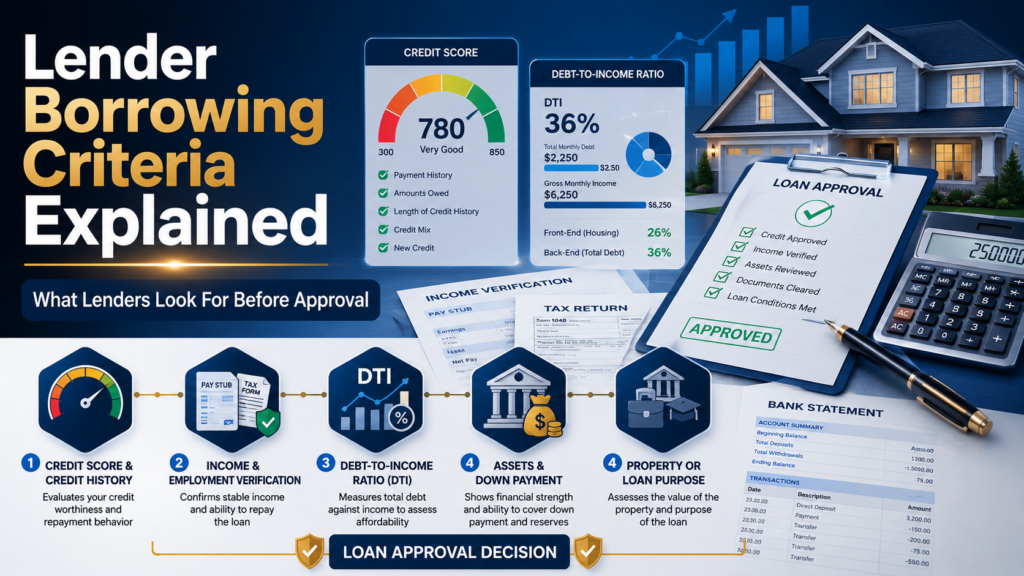
Whether you’re applying for a mortgage, personal loan, student loan, or small business loan, lender borrowing criteria are the gatekeepers standing between you and your financing. These are the specific financial standards that banks, credit unions, mortgage companies, and government-backed lenders use to decide if you’re a trustworthy borrower. Understanding lender borrowing criteria before you apply can make the difference between approval and rejection β€” or between a competitive interest rate and a costly one. This guide breaks down exactly what lenders look for, how each factor is evaluated, and what you can do to strengthen your application. We cover the full underwriting process from credit scores and income verification to debt-to-income ratios and asset liquidity. Whether you’re a first-time homebuyer, a student exploring loan options, or a business owner applying for an SBA loan, this article gives you the practical knowledge to move forward with confidence. What Is Lender Borrowing Criteria?Β  Lender borrowing criteria vary depending on the type of loan, the lender, and whether the loan is conventional, government-backed, or commercial. However, most lenders evaluate borrowers across five core areas: credit history, income and employment, debt-to-income ratio, assets, and the property or purpose of the loan The 5 Core Lender Borrowing Criteria Lenders use a structured underwriting process to evaluate risk. While specific thresholds vary by lender and loan type, five criteria form the foundation of nearly every loan decision in the United States. 1. Credit Score and Credit History Your credit score β€” most commonly a FICO score is one of the most influential factors in any lending decision. FICO scores range from 300 to 850. Most conventional mortgage lenders require a minimum FICO score of 620, while FHA loans may allow scores as low as 500 with a larger down payment. The three major credit bureaus β€” Equifax, TransUnion, and Experian β€” each generate credit reports. Mortgage lenders typically pull all three and use the middle score. Lenders review not just your score but the underlying history: payment record, length of credit history, credit mix, new inquiries, and amounts owed. According to FICO, payment history accounts for 35% of your score, making on-time payments the single most important factor. Amounts owed (credit utilization) makes up 30%. 2. Income and Employment Verification Lenders need to confirm that you earn enough money, and that your income is stable and likely to continue. This is called verifiable income, and it forms the basis for assessing repayment capacity. Typical documentation includes: Β Recent pay stubs (typically two months) Β W-2 forms from the past two years Β Federal tax returns (especially for self-employed borrowers) Β Bank statements Β Profit and loss statements for business owners Self-employed borrowers often face stricter scrutiny. Lenders may require two years of tax returns filed with the Internal Revenue Service (IRS) and calculate income using net profit rather than gross revenue. Fannie Mae guidelines, which govern conventional conforming loans, require lenders to document income with precision. Employment gaps, recent job changes, or irregular income may trigger additional review. 3. Debt-to-Income Ratio (DTI) Your debt-to-income ratio measures how much of your gross monthly income goes toward existing and new debt payments. It is one of the most important indicators of borrower solvency. DTI is calculated as: Total Monthly Debt Payments / Gross Monthly Income x 100 Lenders evaluate two DTI figures: Β  Β  Β  Front-end DTI: Only housing costs (mortgage principal, interest, taxes, insurance) divided by gross income. Most conventional lenders prefer this below 28%. Β  Β  Β  Back-end DTI: All monthly debts (housing + car loans + student loans + credit cards + other obligations) divided by gross income. Most conventional lenders prefer this below 36-43%. Fannie Mae and Freddie Mac allow DTI ratios up to 45-50% in some cases with compensating factors. FHA loans allow up to 57% back-end DTI in certain circumstances, though lender overlays often apply stricter limits. 4. Assets and Down Payment Lenders evaluate your asset liquidity β€” the money and resources you have available to cover the down payment, closing costs, and financial reserves after closing. Having reserves demonstrates financial stability and reduces lender risk. For conventional loans, a 20% down payment eliminates the need for private mortgage insurance (PMI). However, borrowers can qualify with as little as 3% down through programs like Fannie Mae’s HomeReady or Freddie Mac’s Home Possible. FHA loans require as little as 3.5% down with a credit score of 580 or higher. VA loans and USDA loans offer zero down payment options for eligible borrowers. Assets can include: Β  Β  Β  Checking and savings accounts Β  Β  Β  Investment accounts (stocks, bonds, mutual funds) Β  Β  Β  Retirement accounts (often counted at 60-70% of value) Β  Β  Β  Gift funds (with documentation requirements) Β  Β  Β  Proceeds from sale of existing property 5. Property or Loan Purpose For mortgage loans, the property itself must meet certain standards. An independent appraiser assesses the home’s market value, and lenders will not lend more than the property is worth (loan-to-value ratio or LTV must meet program limits). For SBA loans through the Small Business Administration, the purpose of the loan and how the funds will be used are closely scrutinized. The business must operate for profit, meet SBA size standards, and demonstrate a need for the financing. How to Prepare for Lender Borrowing Criteria: Step by Step Follow these steps before submitting any loan application to maximize your chances of approval and secure the best possible terms. Β  Pull Your Credit Reports β€” Request free credit reports from all three bureaus at AnnualCreditReport.com. Review for errors, disputed accounts, or outdated negative items. Β  Check Your FICO Score β€” Many banks and credit card companies offer free FICO scores. Know your score and understand which tier you fall in before applying. Β  Calculate Your DTI β€” Add up all monthly debt obligations and divide by your gross monthly income. If your back-end DTI exceeds 43%, work on paying down debt before applying. Β  Gather Income Documentation β€” Collect recent pay stubs, W-2s, tax

How Mortgage Amortization Works
Mortgage

How Mortgage Amortization Works | A Clear Guide for Borrowers

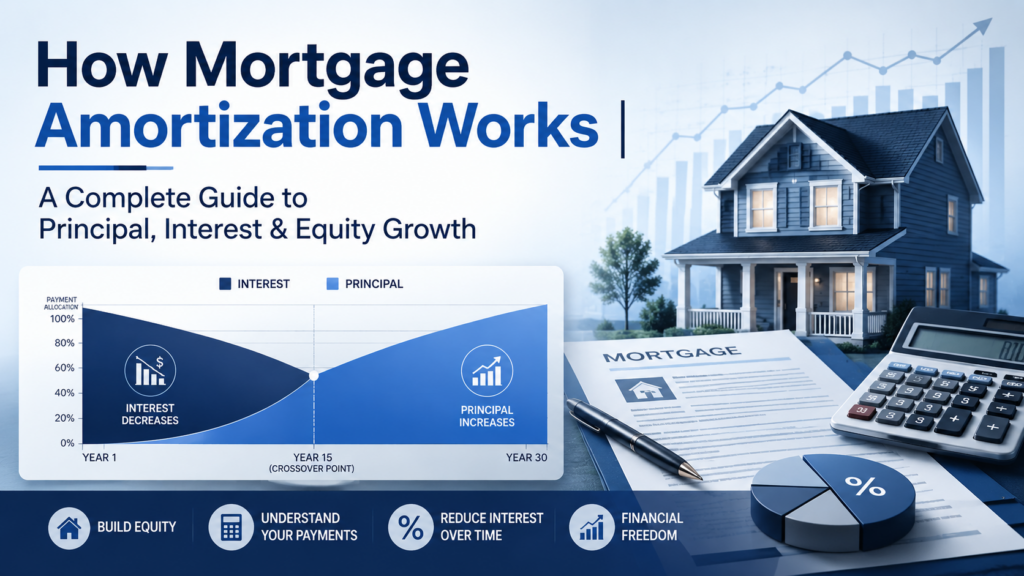
Most homeowners make their monthly mortgage payment without fully understanding where that money goes. The answer lies in how mortgage amortization works β€” a structured debt liquidation process that determines exactly how each dollar of your payment is split between interest and loan principal across the entire life of your loan. Understanding mortgage amortization is not just academic. It affects how much total interest you pay, how quickly you build equity, whether extra payments make sense, and how refinancing decisions should be evaluated. For first-time buyers especially, grasping this concept before signing a loan changes how you approach every payment you’ll make. This guide explains exactly how the amortization process works, walks through the math step by step, shows you a real amortization schedule example, covers negative amortization risk, and explains how different loan types and strategies interact with the reducing balance method. By the end, you’ll have a clear picture of your mortgage from day one to the loan maturity date.Β  The word ‘amortization’ comes from the Latin ‘amortire’ β€” meaning to kill off or extinguish. In mortgage terms, it means systematically extinguishing a debt through regular payments using the reducing balance method. Each periodic installment in a fully amortizing loan is identical in size (for fixed-rate mortgages), but the allocation between interest and principal changes with every payment. This shifting allocation is the core mechanism of mortgage amortization, and it has significant implications for equity accumulation and total interest cost. How Mortgage Amortization Works: The Core Mechanics The Interest-Heavy Early Years The most important thing to understand about mortgage amortization is the interest-heavy early years. Because interest is calculated on the outstanding balance β€” and that balance is highest at the beginning β€” the first years of your mortgage are dominated by interest payments. On a 30-year fixed mortgage, the typical borrower pays far more in interest than in principal during the first decade. This is not a lender trick; it is a mathematical consequence of how compound interest effects work on a large, slowly declining balance. Example: On a $300,000 mortgage at 7% interest over 30 years, the monthly payment is approximately $1,996. In Month 1, roughly $1,750 goes to interest and only $246 goes to principal. By Month 180 (Year 15), the split has shifted to roughly $1,250 interest and $746 principal. By Month 340 (Year 28), the majority of each payment is reducing the balance. The Reducing Balance Method Explained The reducing balance method (also called the declining balance method) calculates interest only on the remaining loan balance, not the original loan amount. This is why interest costs decrease gradually as you pay down the principal. Each month: Β  Β  Β  Your lender calculates interest by multiplying the current outstanding balance by the monthly interest rate (annual rate / 12). Β  Β  Β  The interest amount is subtracted from your fixed payment. Β  Β  Β  The remainder reduces the principal balance. Β  Β  Β  The next month’s interest is calculated on the new, lower balance. This cycle repeats every month until the balance reaches zero the loan maturity date. Payment Allocation Over Time Payment allocation describes how your fixed monthly payment is split between interest and principal at any given point in the loan term. In early years, the ratio is heavily weighted toward interest. In later years, it shifts heavily toward principal reduction. This pattern explains why: Β  Β  Β  Selling or refinancing in the first 5-7 years means you have built relatively little equity through principal payments. Β  Β  Β  Making even one extra principal payment early in the loan has an outsized impact on total interest paid. Β  Β  Β  The straight-line vs declining balance distinction matters most US mortgages use the declining balance method, not a straight-line split. Equity Accumulation Through Amortization Equity accumulation through amortization is the gradual increase in the portion of your home you own outright. Your equity is the difference between the home’s market value and your outstanding loan balance. Amortization builds equity slowly at first and faster later. However, equity also grows when home values appreciate β€” which is separate from the amortization process. Falling home values can reduce equity even when you are making payments on time. Understanding the pace of equity accumulation helps borrowers decide when to refinance, whether to make extra payments, and whether a home equity loan or line of credit is accessible. The Mortgage Amortization Formula The fixed monthly payment for a fully amortizing mortgage calculator using this standard formula:Β  Example calculation: $300,000 loan, 7% annual rate, 30-year term Β  Β  Β  P = $300,000 Β  Β  Β  r = 0.07 / 12 = 0.005833 Β  Β  Β  n = 30 x 12 = 360 Β  Β  Β  M = 300,000 x [0.005833 x (1.005833)^360] / [(1.005833)^360 – 1] Β  Β  Β  M = approximately $1,996 per month Over the full 360 payments, total payments equal roughly $718,560 β€” meaning the total interest paid on this loan is approximately $418,560. This illustrates the compound interest effects of a long-term mortgage and underscores why interest rate and loan term decisions are so consequential. The Truth in Lending Act (TILA), enforced by the Consumer Financial Protection Bureau (CFPB), requires lenders to disclose the total interest you will pay over the full loan term in your Loan Estimate and Closing Disclosure documents. Review these figures carefully before closing. How to Read and Use a Mortgage Amortization Schedule: Step by Step An amortization schedule is a full table showing every payment from loan origination to the loan maturity date. Here is how to read and use it effectively. Obtain Your Amortization Schedule β€” Request your full amortization schedule from your lender at closing, or generate one using Bankrate’s mortgage calculator, Rocket Mortgage’s online tools, or Microsoft Excel Amortization Templates available from Microsoft’s template library. Identify the Four Columns β€” Every amortization schedule has four core columns: Payment Number (or Date), Beginning Balance, Payment Amount (broken into Interest and Principal), and Ending Balance. Locate these

Real Cost of Refinancing
General

The Real Cost of Refinancing | What Every Homeowner Must Know

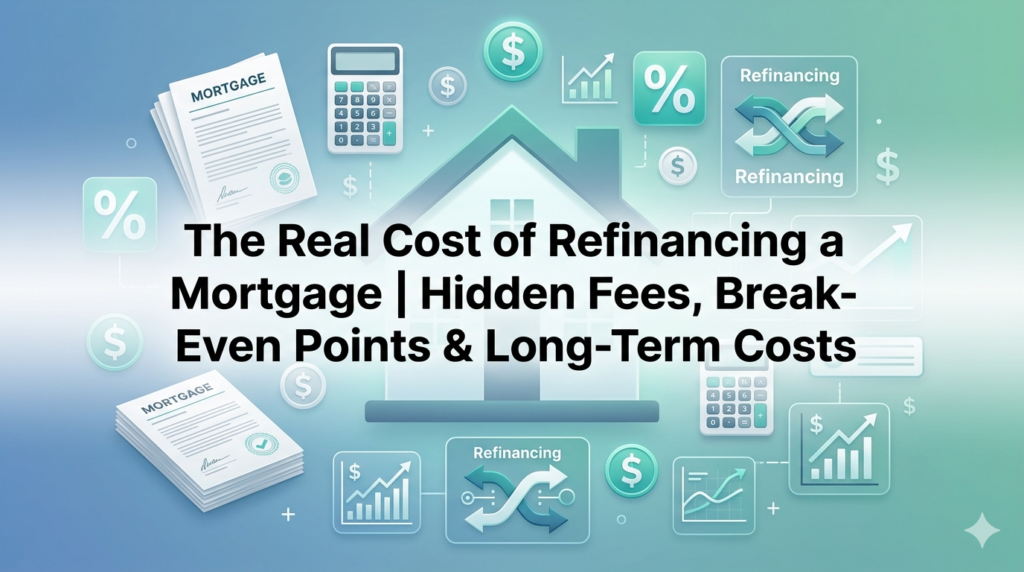
Refinancing sounds straightforward: get a lower rate, pay less each month, save money. But the real cost of refinancing is rarely what it appears on the surface. Between closing fees, loan-to-value ratio requirements, escrow account balance adjustments, and the risk of mortgage term extension, the true financial picture is more complex than a lower monthly payment suggests. Many homeowners across high-cost markets like New York City and California refinance without fully accounting for upfront expenses β€” and end up paying more over time than if they had stayed with their original loan. Understanding the complete cost of a refinance is the difference between a smart financial move and an expensive mistake. This guide covers every component of the real cost of refinancing: closing costs, break-even analysis, rate differentials, hidden fees, PMI implications, and the situations where refinancing does β€” and does not β€” make financial sense. Data from Freddie Mac, the Federal Reserve, the Consumer Financial Protection Bureau, and major lenders like Rocket Mortgage and Chase Bank inform the framework throughout. What Is the Real Cost of Refinancing?Β  The Consumer Financial Protection Bureau (CFPB) emphasizes that refinancing decisions should account for the full cost of the transaction, not just the monthly payment reduction. A refinance that appears to save $200/month but costs $8,000 in closing fees requires 40 months of unchanged ownership just to break even. What Closing Costs Are Included in a Refinance? Closing costs on a refinance are the upfront expenses paid to complete the new loan transaction. These typically total 2% to 6% of the loan amount, varying by loan size, lender, state, and loan type. On a $350,000 loan, this range represents $7,000 to $21,000 in upfront expenses. Lender Fees Lender fees are paid directly to the mortgage company and include: Origination fee: Often 0.5% to 1% of the loan amount. Covers the lender’s cost of processing the loan. Underwriting fee: Typically $400 to $900. Covers the cost of evaluating your financial profile and underwriting criteria review. Application fee: Some lenders charge $75 to $300 just to apply. Many waive this fee β€” always ask. Rate lock fee: If you lock your rate for an extended period (60-90 days), some lenders charge a fee. Lenders registered with the Nationwide Multistate Licensing System (NMLS) are required to disclose all fees on the Loan Estimate within three business days of your application. Review this document carefully and compare across multiple lenders. Third-Party Fees Third-party fees are paid to outside service providers and typically include: Appraisal fee: $300 to $700 depending on property type and location. High-cost markets like New York City and California often run toward the top of this range. Title search and insurance: $500 to $1,500. Confirms ownership and protects against title defects. Attorney fees: Required in some states. Varies widely by location. Survey fee: May be required, typically $150 to $400. Credit report fee: $30 to $50. Government and Recording Fees Recording fees: $25 to $250, paid to the county to record the new mortgage. Transfer taxes: Required in some states and localities. In New York City and parts of California, transfer taxes on refinances can be significant β€” always verify local requirements before estimating total cost. Prepayment penalty: Some existing mortgages carry prepayment penalties if paid off early. Review your current loan documents before initiating a refinance. Escrow Account Balance Adjustments An often-overlooked component of the real cost of refinancing is the escrow account balance. When you refinance, your existing escrow account (holding funds for property taxes and insurance) is typically returned to you β€” but it may take 30-45 days. Meanwhile, your new lender will collect upfront escrow deposits for your new loan, which can require 2-3 months of property tax and insurance payments at closing. In practice, this means you may need to fund a new escrow account even while waiting for your old one to be refunded. This can represent $2,000 to $6,000 or more in additional cash needed at closing in high-tax areas. The Financial Break-Even Analysis: The Most Important Calculation The break-even point is the number of months you must remain in your home with the new loan before your monthly savings exceed your upfront refinancing costs. This is the single most important calculation in any refinancing decision.Important nuances to the break-even calculation: Tax deductibility: Mortgage interest is deductible for many itemizing homeowners, which affects the true after-tax savings. Consult a tax professional for your specific situation. Interest rate differential: The interest rate differential between your old and new loan drives monthly savings. A 0.5% rate reduction on a $300,000 balance saves roughly $80-$100/month. A 1.5% reduction saves roughly $250-$280/month. Exact amounts vary with your specific loan. Opportunity cost: Upfront expenses paid in cash represent money that could have earned returns elsewhere. Some financial models account for this opportunity cost in the break-even calculation. No-Closing-Cost Refinance: Lower Upfront, Higher Long-Term Cost A no-closing-cost refinance rolls all upfront expenses into the loan balance or accepts a higher interest rate in exchange for the lender covering closing costs. This eliminates the cash needed at closing but increases either the loan amount or the monthly interest cost β€” shifting expenses from upfront to long-term. No-closing-cost refinances are best evaluated by calculating the total interest paid over the expected remaining ownership period, not just the break-even point. Bankrate and Zillow Home Loans both offer refinance calculators that model this comparison. The Hidden Cost of Mortgage Term Extension One of the most significant and frequently overlooked costs of refinancing is mortgage term extension. When a homeowner who is 8 years into a 30-year loan refinances into a new 30-year loan, they add 8 additional years of payments to their financial obligation. Even if the new interest rate is lower, the extended term means more total interest paid over the combined lifetime of both loans. This is not a risk β€” it is a mathematical certainty unless the rate reduction is substantial enough to offset the additional years of interest. Example: A homeowner 10

Front-End DTI vs Back-End DTI
General

Front-End DTI vs Back-End DTI | A Complete Guide for Borrowers

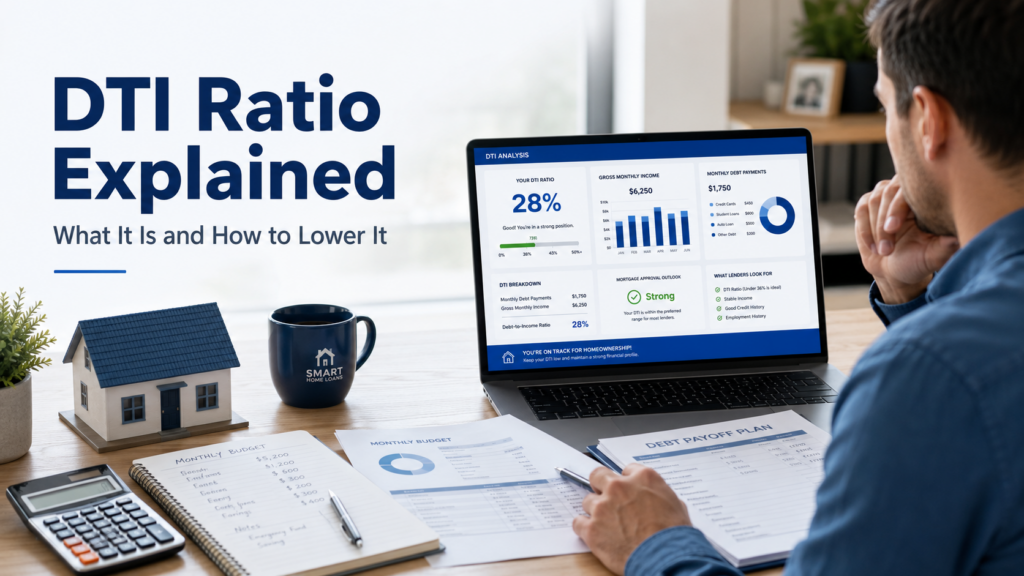
When you apply for a mortgage, two numbers carry more weight than almost any other factor in the underwriting process: your front-end DTI and your back-end DTI. These two debt-to-income ratios tell lenders how much of your income is already committed to housing and to debt broadly and together they define your mortgage eligibility before your credit score, down payment, or loan type even enters the conversation. Understanding front-end DTI vs back-end DTI is essential for any borrower who wants to know where they stand before applying. Many first-time buyers are surprised to discover that a strong credit score does not compensate for a back-end DTI that exceeds lender thresholds. Others underestimate how housing costs beyond the mortgage payment taxes, insurance, HOA feesΒ  affect their front-end ratio. This guide explains exactly what each ratio measures, how to calculate both, what limits apply across different loan programs including FHA, VA, USDA, and conventional loans, and what practical steps can improve your ratios before you apply. Tools from Rocket Mortgage, Bankrate, and Zillow Home Loans can help you run these numbers β€” but understanding the mechanics first puts you in a stronger position to act on the results. What Is Front-End DTI vs Back-End DTI?Β  The Consumer Financial Protection Bureau (CFPB) identifies debt-to-income ratio as one of the primary factors lenders use in mortgage qualification decisions. While no single DTI threshold is universally mandated by law, the Qualified Mortgage (QM) framework β€” which gives lenders legal protections β€” has historically aligned with back-end DTI limits near 43%, though Fannie Mae and Freddie Mac allow higher ratios in specific scenarios. Front-End DTI: The Housing Expense Ratio Explained Front-end DTI also called the housing expense ratio or housing ratio β€” focuses exclusively on the costs of housing. It answers one question: what percentage of your gross monthly income goes toward paying for your home? What Is Included in Front-End DTI? Front-end DTI includes all components of your monthly housing payment, commonly abbreviated as PITI: Principal: The portion of your mortgage payment that reduces the loan balance. Interest: The cost of borrowing, calculated on the remaining loan balance. Taxes: Monthly property tax portion, typically held in escrow. Insurance: Homeowner’s insurance monthly escrow portion. HOA fees: If applicable, homeowners association fees are included. Private mortgage insurance (PMI): If your down payment is below 20% on a conventional loan, PMI is included. The formula is: Front-End DTI = Monthly Housing Costs (PITI) / Gross Monthly Income x 100 Front-End DTI Example Gross monthly income: $6,500 Estimated PITI (mortgage P&I + taxes + insurance + HOA): $1,690 Front-End DTI: 1,690 / 6,500 x 100 = 26% This borrower falls within the commonly referenced 28% front-end guideline and would meet the housing expense threshold for most conventional lenders. Why Front-End DTI Matters The front-end ratio captures the affordability index for housing specifically. A borrower with low overall debt but a very high housing payment relative to income can still face financial strain. Lenders use this ratio to ensure that the housing obligation itself β€” regardless of other debts β€” is proportionate to income. In practice, front-end DTI is most closely scrutinized for FHA loans, which have an official 31% front-end limit as a standard guideline. For conventional loans following Fannie Mae and Freddie Mac guidelines, there is no strict front-end cap β€” though most lenders apply a practical 28-31% benchmark in their creditworthiness analysis. Back-End DTI: The Total Debt Ratio Explained Back-end DTI also called the total debt ratio provides a wider view of a borrower’s financial obligations. It includes housing costs plus every other recurring monthly debt payment, making it the more comprehensive measure of income-to-debt relationship. What Is Included in Back-End DTI? Back-end DTI includes all housing costs (same as front-end DTI) plus: Auto loan payments Student loan payments (minimum required payment or calculated payment per loan program rules) Credit card minimum monthly payments Personal loan installments Child support or alimony payments (if obligated) Co-signed loan payments (if you are legally obligated) Any other recurring monthly installment or revolving debt obligations The formula is: Back-End DTI = (Total Monthly Housing Costs + All Monthly Debt Payments) / Gross Monthly Income x 100 Back-End DTI Example Gross monthly income: $6,500 Monthly housing costs (PITI): $1,690 Other monthly debts: $850 (car loan $450 + student loans $250 + credit card minimums $150) Total monthly obligations: $2,540 Back-End DTI: 2,540 / 6,500 x 100 = 39.1% This borrower’s back-end DTI of 39.1% exceeds the classic 36% guideline but falls within Fannie Mae’s expanded 45% limit. Depending on their FICO score and reserves, a conventional loan may still be achievable. An FHA loan could also accommodate this ratio with compensating factors. Why Back-End DTI Is the More Critical Number While front-end DTI measures housing affordability, back-end DTI is the underwriting risk factor that lenders weight most heavily. A borrower may have a modest housing payment but carry significant debt from student loans, auto loans, or credit cards. Back-end DTI captures this total picture and reveals the borrower’s personal finance liquidity β€” how much income remains after all obligations are met (discretionary income). FICO research supports the relationship between high back-end DTI and elevated default risk. Lenders use back-end DTI alongside FICO scores and loan-to-value ratios as the three primary factors in lending cap threshold decisions. Front-End and Back-End DTI Limits by Loan Program Different loan programs set different official DTI thresholds. Understanding which program’s limits apply to your situation helps you evaluate your mortgage eligibility accurately before applying. Conventional Loans: Fannie Mae and Freddie Mac Conventional conforming loans follow Fannie Mae and Freddie Mac guidelines. There is no official front-end DTI cap in Fannie Mae’s Selling Guide, though most lenders apply a 28% practical threshold. The back-end DTI limit is typically 45% through automated underwriting systems (DU for Fannie Mae, LPA for Freddie Mac), with some approvals reaching 50% for borrowers with strong FICO scores and significant reserves. Manual underwriting of conventional loans generally applies stricter DTI caps, often 36-45%

Mortgage Can You Afford
Mortgage

How Much Mortgage Can You Afford? A Complete Guide

Figuring out how much mortgage you can afford is the most important first step before buying a home. Borrow too little and you may miss out on the home you want. Borrow too much and you risk financial strain that can follow you for decades. The good news is that answering “mortgage can you afford” is not guesswork. Lenders, government agencies like the Federal Housing Administration (FHA) and the Department of Veterans Affairs (VA), and tools from Fannie Mae and Freddie Mac all offer clear frameworks for calculating your safe borrowing limit. This guide walks you through exactly how affordability is calculated, what rules lenders use, how to use tools like the Zillow Affordability Calculator, and what mistakes to avoid before applying for a loan. What Does Mortgage Affordability Mean? Mortgage affordability refers to the maximum home loan amount a borrower can comfortably repay based on their income, existing debts, credit profile, and monthly expenses. It is not simply how much a lender will approve β€” it is how much you can actually manage without stretching your financial solvency. Lenders measure this using two core ratios: the front-end debt ratio (housing costs vs. gross income) and the back-end debt ratio (all monthly debts vs. gross income). Together, these form the basis of what is commonly called qualified mortgage standards set by the Consumer Financial Protection Bureau (CFPB). The 28/36 Rule of Thumb Explained The 28/36 rule is the most widely used benchmark in mortgage affordability. It works as follows: Front-end ratio: Your monthly housing costs (PITI β€” Principal, Interest, Taxes, and Insurance) should not exceed 28% of your gross monthly income. Back-end ratio: Your total monthly debt payments β€” including the mortgage, car loans, student loans, and credit card minimums β€” should not exceed 36% of your gross monthly income. Practical Example Using the 28/36 Rule Suppose your gross monthly income is $7,000: 28% of $7,000 = $1,960 maximum for housing (PITI mortgage bundle) 36% of $7,000 = $2,520 maximum for all debts combined If you already pay $400/month in car payments and $200 in student loans, your remaining mortgage budget is: $2,520 – $600 = $1,920/month Note: Some lenders β€” particularly those offering FHA loans β€” allow back-end ratios up to 43% or higher for borrowers with strong compensating factors. Conventional loans backed by Fannie Mae or Freddie Mac typically follow stricter guidelines. Key Factors That Determine How Much Mortgage You Can Afford Gross Monthly Income Lenders look at your total pre-tax income from all verified sources β€” salary, self-employment, rental income, or investment returns. This forms the baseline for all affordability calculations. Monthly Debt Obligations All recurring minimum debt payments are counted: car loans, credit cards, student loans, personal loans, and any existing mortgage payments. Lower debt means a higher borrowing capacity. Credit Score Your credit score directly affects your interest rate, which affects your monthly payment, which affects how much you can borrow at a given payment level. According to FICO and major bureaus like Experian, Equifax, and TransUnion: 760 and above: Best rates available 700-759: Good rates, most programs accessible 620-699: Limited options; FHA loans typically require at least 580 Below 580: Very limited; may require larger down payment or alternative programs Down Payment A larger down payment reduces the loan amount, lowers the loan-to-value (LTV) ratio, and may eliminate the need for private mortgage insurance (PMI). Conventional loans often require at least 5-20% down, while FHA loans allow as low as 3.5% for qualifying borrowers. Interest Rate and Loan Term Even a 0.5% difference in interest rate can significantly change your monthly payment. A 30-year loan reduces monthly payments compared to a 15-year loan, but you pay more interest over the life of the loan. Rates vary by lender, market conditions, and borrower profile. Property Taxes and Insurance Your PITI mortgage bundle includes property taxes and homeowners insurance. These vary significantly by location and property type. Escrow account management by your lender typically collects these monthly as part of your mortgage payment. How to Calculate How Much Mortgage You Can Afford: Step by Step Calculate your gross monthly income. Add all pre-tax income sources per month. Add up all monthly debt payments. Include minimum payments on every account. Apply the 28% front-end rule. Multiply your gross income by 0.28 to find your maximum housing payment. Apply the 36% back-end rule. Multiply gross income by 0.36, then subtract existing monthly debts. This is your maximum mortgage payment. Estimate property taxes and insurance. Contact local tax authorities or get insurance quotes. Subtract these from your maximum housing budget. Use an affordability calculator. Tools like the Zillow Affordability Calculator or the NerdWallet Mortgage Tool can estimate your max loan amount based on these inputs. Get pre-approved. Work with lenders like Rocket Mortgage, Bank of America, or Chase Home Lending to receive an official pre-approval letter that confirms your real borrowing limit. Government Programs That Affect Mortgage Affordability FHA Loans (Federal Housing Administration) FHA loans are insured by the Federal Housing Administration and are designed for first-time buyers and those with lower credit scores. They allow down payments as low as 3.5% with a credit score of 580 or higher. FHA loans permit back-end ratios up to 43% β€” or higher with compensating factors. VA Loans (Department of Veterans Affairs) VA loans are available to eligible service members, veterans, and surviving spouses through the Department of Veterans Affairs. They require no down payment, no PMI, and offer competitive interest rates. The VA uses a residual income approach rather than strict debt-to-income ratios. Fannie Mae and Freddie Mac Conventional Loans Conventional loans sold to Fannie Mae or Freddie Mac must meet their underwriting guidelines, which typically require a debt-to-income ratio of no more than 45-50% for automated approvals, a credit score of at least 620, and private mortgage insurance if the down payment is under 20%. USDA Loans USDA loans are available for eligible rural and suburban homebuyers and offer zero-down-payment options. Income limits apply and vary by location.

Pay Off Your Mortgage
Mortgage

How to Pay Off Your Mortgage Early | Smart Strategies That Work

Deciding to pay off your mortgage early is one of the most debated personal finance decisions a homeowner can make. For some, eliminating a mortgage means financial freedom no more monthly housing obligation, a fully owned home, and guaranteed compound interest savings. For others, the opportunity cost of capital suggests that money may work harder elsewhere. The right answer depends on your interest rate, tax situation, available liquid assets vs home equity, and broader financial goals. This guide walks through every proven strategy to pay off your mortgage early, explains the real math behind each approach, and helps you decide whether early payoff is the right move for your situation. You will also find a clear comparison table, common mistakes to avoid, and answers to the most frequently asked questions homeowners have before accelerating their mortgage payoff. What Does It Mean to Pay Off Your Mortgage Early? Paying off your mortgage early means retiring your home loan before the end of its scheduled amortization table term β€” typically 30 or 15 years. It helps homeowners eliminate interest costs, build full home equity, and free up monthly cash flow optimization. The main purpose is to reduce the total cost of homeownership and achieve financial independence from a monthly debt obligation. Early payoff can happen all at once through a one-time lump-sum payment, or gradually through consistent extra principal contributions over time. Both approaches alter the amortization table impact β€” compressing the repayment schedule and dramatically cutting total interest paid over the life of the loan. Why Homeowners Consider Paying Off Their Mortgage Early Guaranteed Return on Investment Every extra dollar applied to your mortgage principal generates a guaranteed return on investment equal to your interest rate. If your mortgage rate is 6.5%, paying down the balance is the equivalent of earning 6.5% risk-free β€” which is competitive with many investment alternatives, particularly in periods of market volatility. Financial Freedom and Peace of Mind According to Ramsey Solutions, eliminating a mortgage is one of the most cited financial goals among American homeowners. Owning your home outright removes your largest monthly fixed expense and reduces vulnerability to job loss, income disruption, or economic downturns. Compound Interest Savings Mortgage interest is front-loaded in the amortization schedule. In the early years of a 30-year mortgage, the majority of each payment goes toward interest rather than principal. Making extra payments early in the loan term eliminates future interest charges on those dollars β€” producing outsized compound interest savings compared to late-stage extra payments. The Opportunity Cost of Capital Argument Not all financial experts recommend early payoff. The opportunity cost of capital argument holds that if your mortgage rate is below the long-term expected return of a diversified investment portfolio, keeping the mortgage and investing the difference may produce greater wealth over time. This is a valid consideration, but it carries investment risk that paying down a mortgage does not. Always factor in your personal risk tolerance, investment horizon, and tax situation. How to Pay Off Your Mortgage Early: Step by Step Review your mortgage statement and amortization table. Confirm your current balance, interest rate, remaining term, and monthly principal vs. interest split. This establishes your baseline. Check for a prepayment penalty clause. Some mortgages β€” particularly older loans or certain non-conventional products β€” include prepayment penalty clauses that charge a fee for paying off the loan early or making payments above a set threshold. Contact your servicer (Wells Fargo Home Mortgage, Chase Bank, SoFi, or whoever holds your loan) to confirm. Identify how much extra you can consistently apply. Even an additional $100 to $200 per month can shave years off a 30-year mortgage and save tens of thousands in interest. Use an online amortization calculator to model different scenarios. Choose your payoff strategy. Options include: extra monthly principal payments, biweekly payments, a one-time lump-sum payment, mortgage recasting, or refinancing to a shorter term. Each strategy is detailed in the section below. Designate extra payments as principal-only. Contact your loan servicer to ensure any additional payments are applied directly to the principal balance β€” not held as an advance payment toward the next month’s bill. Consider windfall allocation strategy. If you receive a tax refund, bonus, inheritance, or other windfall, applying all or part of it to your principal produces a large one-time amortization table impact without affecting your monthly budget. Monitor your amortization table monthly. Track how each extra payment shortens your payoff date and reduces total interest. This reinforces progress and helps you stay on track. Weigh liquid assets vs home equity before accelerating payoff. Ensure you maintain adequate emergency reserves and retirement contributions before redirecting cash to your mortgage. Home equity is not liquid β€” you cannot access it quickly in an emergency without refinancing or selling. Consult a tax professional about mortgage interest deduction loss. The Internal Revenue Service (IRS) allows itemizing homeowners to deduct mortgage interest. Paying off your mortgage eliminates this deduction. A tax professional can help you assess whether you benefit from itemizing and what the net tax impact of early payoff would be. 7 Proven Strategies to Pay Off Your Mortgage Early Make Extra Monthly Principal Payments Adding a fixed amount β€” even $100 or $200 β€” to your principal each month is the simplest and most consistent strategy. On a $300,000 mortgage at 6.5% over 30 years, adding $200/month extra can cut approximately 5 years off the loan and save over $60,000 in interest. Actual results vary by loan balance and rate. Switch to Biweekly Payments Instead of making 12 monthly payments per year, biweekly payments result in 26 half-payments β€” the equivalent of 13 full monthly payments. This extra annual payment goes entirely toward the principal, shaving years off the loan term without a noticeable change to your monthly budget. Important: Confirm your servicer supports true biweekly payment processing. Some servicers hold the first half-payment and apply both together at the regular due date, which does not produce the same benefit. Apply a One-Time Lump-Sum

Mortgage Affordability Calculator
Mortgage

Mortgage Affordability Calculator | Find Your True Budget

A mortgage affordability calculator is one of the first tools any homebuyer should use. Before you visit a lender, tour a property, or even browse listings, knowing your housing budget analysis gives you a realistic starting point and saves time throughout the buying process. The challenge is that calculators vary widely. Some give you a simple number based on income alone. Others factor in debts, property taxes, insurance, and current interest rates to produce a more accurate picture of your actual borrowing power. Understanding what goes into the calculation β€” and how to use the results β€” makes a significant difference. This guide explains how mortgage calculators work, which inputs matter most, how to compare the best tools from Zillow, Bankrate, NerdWallet, and Rocket Mortgage, and what to do with your results before applying for a loan. What Is a Mortgage Affordability Calculator? A mortgage affordability calculator is a digital tool that estimates the maximum home price or loan amount a borrower can qualify for based on their financial profile. It helps buyers understand their housing budget before approaching a lender. The main purpose is to give borrowers a realistic sense of their borrowing power so they can shop for homes within their actual financial reach. These calculators are offered by lenders, real estate platforms, and government-affiliated organizations including the Consumer Financial Protection Bureau (CFPB). While results are estimates β€” not guarantees β€” they give buyers a solid baseline before starting the pre-approval process. How Does a Mortgage Affordability Calculator Work? Most calculators take a set of financial inputs and apply standard lending ratios to estimate a safe borrowing limit. The core math is based on two key ratios used by lenders and agencies including Fannie Mae and Freddie Mac: Front-end ratio (housing expense ratio): Monthly housing costs should not exceed 28% of gross monthly income. Back-end ratio (financial debt load): Total monthly debt payments β€” including the mortgage β€” should not exceed 36% to 43% of gross monthly income. The calculator uses your inputs to estimate a monthly payment that fits within these ratios, then works backward to determine the home price that generates that payment at a given interest rate and loan term. Key Inputs Most Calculators Require Gross monthly income (before taxes) Monthly debt payments (car loans, student loans, credit cards) Down payment amount or percentage Estimated interest rate or credit score range Loan term (typically 15 or 30 years) Property taxes and homeowners insurance (estimated) HOA fees if applicable More advanced calculators from platforms like Zillow, Bankrate, and NerdWallet also factor in private mortgage insurance (PMI) for down payments under 20%, escrow account management estimates, and local tax data to give more accurate results. How to Use a Mortgage Affordability Calculator: Step by Step Gather your financial documents. Before entering any numbers, collect your recent pay stubs, tax returns, and a list of all monthly debt obligations. Enter your gross monthly income. Use your pre-tax income from all verified sources β€” salary, freelance, rental income, or other documented earnings. Input your monthly debts. Add minimum monthly payments for all recurring debts: car loans, student loans, credit card minimums, and personal loans. Do not include utilities or groceries. Enter your down payment. Use the actual amount you have saved. A higher down payment reduces your loan amount, lowers your monthly payment, and may remove PMI. Set your loan term and interest rate. Choose 15 or 30 years. Enter a rate based on your credit score range, or use the calculator’s current market rate estimate. Add property taxes and insurance. Use the calculator’s estimates or research local property tax rates and request insurance quotes for a more accurate figure. Review the results. The calculator will show a maximum home price, estimated monthly payment, and sometimes a breakdown of principal, interest, taxes, and insurance (PITI). Adjust inputs to stress-test your budget. Try raising the interest rate by 1% or reducing your down payment to see how your affordability changes. This helps you understand your sensitivity to rate changes. Use results as a starting point. Take the calculator output to a lender for a formal pre-qualification or mortgage pre-approval process. The lender will verify all inputs with documentation. Comparing the Best Mortgage Affordability Calculators Not all calculators are built the same. The depth of inputs, accuracy of defaults, and quality of explanations vary significantly. Here is how the most widely used tools compare: Calculator Provider Taxes/Insurance DTI Ratio Shown Best For Zillow Zillow Yes (local data) Yes (front & back) Buyers wanting local tax estimates and a visual breakdown Bankrate Bankrate Yes (editable) Yes Borrowers who want to adjust every variable manually NerdWallet NerdWallet Yes (estimated) Yes Beginners who want a guided, easy-to-read result Rocket Mortgage Rocket Mortgage Yes Partial Buyers ready to move toward pre-approval quickly CFPB Tool CFPB Basic Educational Beginners wanting unbiased, government-backed guidance Key Terms You Will See in a Mortgage Affordability Calculator Gross Monthly Income This is your total household income before taxes and deductions. Lenders use gross income β€” not take-home pay β€” as the baseline for all affordability calculations. If you are self-employed, lenders typically average two years of net income from tax returns. Front-End and Back-End Ratio The front-end ratio (also called the housing expense ratio) compares your monthly housing costs to your gross income. The back-end ratio compares all monthly debts to gross income. Most conventional lenders follow Fannie Mae and Freddie Mac guidelines allowing back-end ratios up to 45-50% for strong applicants. Debt Service Coverage and Financial Debt Load Debt service coverage refers to how well your income covers your total debt obligations. A high financial debt load β€” meaning too many existing debts relative to income β€” directly reduces your borrowing power in any affordability calculator. Principal and Interest (P&I) Principal and interest are the two core components of your mortgage payment. The principal is the amount you borrowed; the interest is the lender’s fee for the loan. Most calculators show P&I separately from taxes and insurance so

Mortgage Refinancing
Mortgage

Mortgage Refinancing Explained | Is It the Right Move for You?

Mortgage refinancing is one of the most powerful financial tools available to homeowners β€” but it is not always the right move. Done at the right time and for the right reasons, refinancing can lower your monthly payment, cut tens of thousands in total interest, or unlock home equity for major expenses. Done at the wrong time, it can extend your debt, increase your costs, and reset progress toward payoff. The decision is driven by the current interest rate environment, your creditworthiness, how much equity you have built, and how long you plan to stay in your home. Lenders such as Rocket Mortgage, Chase Bank, United Wholesale Mortgage, Better.com, and Navy Federal Credit Union each offer different refinancing products, and the right choice depends on your specific goals. This guide explains what mortgage refinancing is, how the underwriting process works, the main types of refinance loans available, step-by-step how to refinance, common mistakes to avoid, and how to decide whether refinancing makes sense for your situation right now. What Is Mortgage Refinancing? Mortgage refinancing is the process of replacing your existing home loan with a new mortgage β€” typically with different terms, a new lender, or both. It helps homeowners reduce their interest rate, adjust their loan term, lower monthly payments, or access their home equity through equity withdrawal. The main purpose is to improve the financial terms of your existing mortgage based on changes in your financial profile or the broader interest rate environment. When you refinance, your new lender pays off your original mortgage and issues a replacement loan. You restart the amortization schedule on the new loan, which affects both your payment structure and your total interest cost over time. Types of Mortgage Refinancing Rate-and-Term Refinance The most common type of refinancing. You replace your current loan with a new one at a lower interest rate, a different loan term, or both β€” without changing the principal balance significantly. The primary goal is to reduce monthly payments or cut total interest paid over the life of the loan. Cash-Out Refinance A cash-out refinance replaces your existing mortgage with a larger loan and pays you the difference in cash. For example, if your home is worth $400,000 and you owe $250,000, you might refinance for $300,000 and receive $50,000 in cash. This is a form of equity withdrawal that converts home equity into liquid funds for renovations, debt consolidation, education, or other needs. Fannie Mae and Freddie Mac generally allow cash-out refinances up to 80% of the home’s appraised value for conventional loans. FHA and VA programs have their own equity withdrawal limits and eligibility requirements. Cash-In Refinance The opposite of a cash-out refinance. You bring cash to the closing table to pay down your principal balance β€” reducing the new loan amount and potentially qualifying for a better interest rate or eliminating private mortgage insurance (PMI). Streamline Refinance (FHA and VA) The Federal Housing Administration and the Department of Veterans Affairs offer streamline refinance programs that simplify the underwriting process for existing FHA or VA loan holders. These programs typically require less documentation, may allow an appraisal waiver, and involve reduced underwriting process steps compared to conventional refinancing. The FHA Streamline requires a seasoning period of at least 210 days from the first payment date of the original loan, and you must have made at least six on-time payments. The VA Interest Rate Reduction Refinance Loan (IRRRL) has similar seasoning requirements. Details vary β€” verify current terms with your servicer or lender. No-Closing-Cost Refinance Some lenders β€” including Better.com and others β€” offer no-closing-cost refinancing options where upfront fees are rolled into the loan balance or offset by a slightly higher interest rate. This lowers the break-even timeline but increases total interest paid over the loan term. It may make sense for borrowers who plan to move or refinance again within a few years. How Mortgage Refinancing Works When you refinance, you go through a process similar to your original mortgage application. Your new lender evaluates your creditworthiness, income, employment, property value, and existing debts. Here is what happens at each stage: Application and Documentation You apply with a lender β€” Rocket Mortgage, United Wholesale Mortgage (through a broker), Chase Bank, Navy Federal Credit Union, or another provider β€” and submit financial documentation including recent pay stubs, W-2s or tax returns, bank statements, and your current mortgage statement. Credit Review and Creditworthiness Assessment The lender pulls your credit report and evaluates your credit score, payment history, and existing debt obligations. Conventional refinance lenders typically require a minimum credit score of 620 for rate-and-term refinancing. Cash-out refinances often require 640 or higher. VA and FHA streamline programs may be more flexible. Credit score requirements vary by lender and loan type. Home Appraisal Most refinance loans require an independent home appraisal to confirm the property’s current market value. The appraisal determines how much equity you have β€” which affects the loan-to-value (LTV) ratio and the terms available. Some programs, including Fannie Mae’s Desktop Underwriter and Freddie Mac’s Loan Product Advisor, may grant an appraisal waiver for eligible borrowers based on automated valuation data. Underwriting Process The lender’s underwriting process involves verifying all submitted information and confirming the loan meets program guidelines. The underwriter reviews your financial solvency, debt-to-income ratio, property details, and title insurance documentation. This stage typically takes 2 to 6 weeks, depending on the lender and loan complexity. Closing and Escrow Account Setup At closing, you sign the new loan documents, pay any applicable closing costs (or roll them into the loan), and the lender funds the new mortgage. Your new lender pays off the old loan. An escrow account is typically established or transferred to collect property taxes and homeowners insurance going forward. There is a 3-day right of rescission for most refinances on a primary residence, during which you can cancel without penalty. This does not apply to purchases or investment property refinances. How to Refinance Your Mortgage: Step by Step Define your refinancing

Refinance vs Recast
Mortgage

Refinance vs Recast | Which Mortgage Strategy Saves You More?

When you come into extra cashΒ  whether from a bonus, an inheritance, or the sale of another property your mortgage suddenly looks like a prime target for improvement. Two popular strategies compete for your attention: refinance vs recast. Both can lower your monthly payment, but they work in completely different ways, carry different costs, and suit different borrower profiles. A refinance means applying for a brand-new loan to replace the old one. A recast (also called a mortgage recast or loan recast) means keeping your current loan but reducing the balance with a large lump-sum payment, after which the lender recalculates your monthly payment over the remaining term. This guide breaks down how each option works, what it costs, when each one makes sense, and how to avoid the most common mistakes borrowers make when choosing between them. By the end, you will have a clear framework for deciding which path fits your situation. What Is Refinance vs Recast? A mortgage refinance is the process of paying off your current mortgage with a new loan that carries different terms β€” such as a lower interest rate, a shorter or longer loan term, or a different loan type (e.g., switching from an adjustable-rate mortgage to a fixed-rate mortgage). It helps borrowers reduce their monthly payment, access home equity, or lower their total interest cost. The main purpose is to improve the financial terms of the debt. A mortgage recast is an administrative loan modification in which the borrower makes a large lump-sum payment toward the principal balance, and the lender recalculates (re-amortizes) the monthly payment based on the reduced balance, the same interest rate, and the remaining loan term. It helps borrowers lower their monthly obligation without changing the loan’s core terms. The main purpose is to reduce the payment using available cash while keeping the existing loan intact. How Refinancing Works When you refinance, your lender β€” or a new lender such as Rocket Mortgage, Chase Home Lending, SoFi Technologies, or Bank of America β€” pays off your existing mortgage and issues you a completely new loan. You go through a full underwriting process that includes a credit check, income verification, a home appraisal (in most cases), and a review of your debt-to-income ratio. At closing, you pay closing costs that typically range from 2% to 6% of the new loan amount, according to the Consumer Financial Protection Bureau (CFPB). These costs can be paid out of pocket, rolled into the new loan balance, or offset by a higher interest rate (a no-closing-cost refinance). Common reasons homeowners refinance include: Securing a lower interest rate to reduce monthly payments or total interest paid Shortening the loan term to build equity faster (e.g., moving from a 30-year to a 15-year loan) Switching from an adjustable-rate mortgage (ARM) to a fixed-rate mortgage for payment stability Accessing home equity through a cash-out refinance for home improvements, debt consolidation, or other needs Removing private mortgage insurance (PMI) once the home has appreciated enough Types of Refinance Loans Conventional refinances are backed by Fannie Mae and Freddie Mac guidelines. Government-backed refinance programs include the FHA Streamline Refinance through the Federal Housing Administration, the VA Interest Rate Reduction Refinance Loan (IRRRL) through the Department of Veterans Affairs, and the USDA Streamlined Assist Refinance for eligible rural borrowers. Each program has its own eligibility requirements, credit score thresholds, and mortgage insurance rules. Always verify current guidelines directly with the relevant agency or an approved lender, as these details can change. How Recasting Works A mortgage recast does not create a new loan. Instead, you make a large one-time principal payment β€” lenders typically require a minimum of $5,000 to $10,000 or more, though this varies by lender β€” and then the lender recalculates your monthly payment using the reduced balance. Your interest rate, loan term end date, and loan servicer all stay the same. The fee for recasting is usually modest, often between $150 and $500, depending on the lender and loan servicer. There is no credit check, no income verification, and no appraisal required. Key features of a recast: Applies only to conventional loans (Fannie Mae or Freddie Mac eligible); FHA and VA loans generally cannot be recast Requires lender approval β€” not all servicers offer recasting The interest rate remains unchanged The loan payoff date remains the same Monthly payment drops because the amortization table is recalculated on the smaller balance Does not reset the loan term or restart the amortization schedule from scratch How to Decide Between Refinance and Recast: Step by Step Check your current interest rate. If market rates are significantly lower than your rate β€” generally 0.5% to 1% or more β€” refinancing may produce meaningful savings. If your rate is already competitive, recasting may be the smarter move. Assess your lump-sum cash. Recasting requires a substantial upfront payment. If you have $20,000 or more available without depleting your emergency fund, both options are worth evaluating. Confirm recast eligibility. Contact your loan servicer to verify whether your loan is eligible for recasting. Conventional loans backed by Fannie Mae or Freddie Mac are typically eligible; FHA and VA loans generally are not. Estimate refinance costs. Use a refinance calculator or request a Loan Estimate from lenders to find out your total closing costs. Calculate your break-even point: divide the closing costs by your monthly savings to see how many months it takes to recover the costs. Run the recast math. Ask your servicer how much your monthly payment would drop if you applied a specific lump-sum payment. Compare that savings to what refinancing would provide. Consider your remaining loan term. If you have 10 years or fewer left, the savings from either option may be limited. If you have 20 or more years remaining, the long-term interest impact is larger and worth careful comparison. Factor in your credit and financial profile. Refinancing requires solid credit, stable income, and a manageable debt-to-income ratio. If your financial profile has weakened since you got your

Scroll to Top