Author name: CJ Anderson

The 28/36 Rule Explained
General

The 28/36 Rule Explained | A Smart Guide for Home Buyers

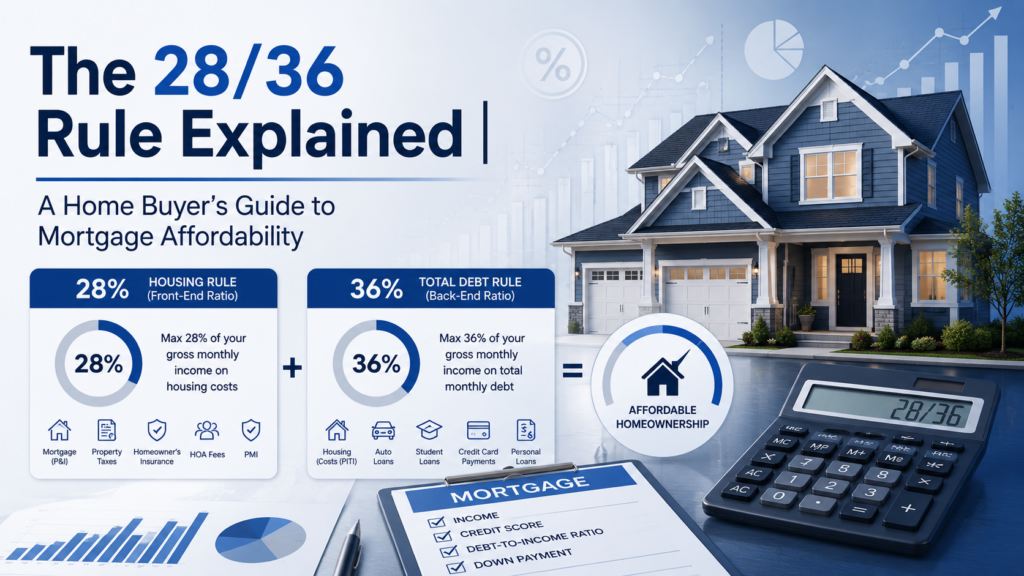
If you’re shopping for your first home or trying to understand how much house you can afford, The 28/36 Rule Explained is one of the most important concepts you’ll encounter. This mortgage affordability guideline gives home buyers a clear, practical framework for evaluating how much they can borrow without overextending their finances. The rule works like this: no more than 28% of your gross monthly income should go toward housing costs, and no more than 36% should go toward all debt combined. These two thresholds — called the front-end ratio and back-end ratio — are the backbone of mortgage underwriting guidelines used by lenders across the United States. Understanding the 28/36 rule explained for home buyers helps you set realistic expectations before you apply, avoid financial stress after you buy, and negotiate your loan from a position of knowledge. This guide covers exactly what the rule means, how to calculate both ratios, where exceptions exist, and how to apply it to your own financial situation. 28/36 Rule Calculator: How Much House Can You Afford? Enter your gross (pre-tax) monthly income and your current monthly debt payments. The calculator shows the largest housing payment the 28/36 rule allows, and a rough home price that payment could support. Change the rate, taxes and down payment to match your situation. Gross monthly income ($) Monthly debt payments, excluding housing ($) Interest rate (%) Loan term (years) Monthly taxes, insurance, HOA ($) Down payment ($) Calculate Max housing payment (28% of income) Max total debt (36% of income) Housing payment allowed by both limits Limit that applies Estimated max loan amount Estimated max home price What Is the 28/36 Rule?  The rule has two distinct components: The 28% front-end limit (also called the housing expense ratio or household expense ratio) covers principal, interest, property taxes, and homeowner’s insurance — sometimes abbreviated as PITI. The 36% back-end limit (also called the total debt ratio) covers PITI plus all other recurring monthly debt payments, including car loans, student loans, credit cards, and personal loans. These percentages are not laws they are affordability benchmarks grounded in decades of mortgage underwriting guidelines and risk mitigation research. Lenders including Rocket Mortgage, Chase Bank, and U.S. Bank use variations of these thresholds in their qualification processes, though actual limits vary by loan type and lender. How the 28/36 Rule Works in Practice The 28% Front-End Ratio: Housing Expense Threshold The front-end ratio measures only your housing costs against your income. It answers the question: what percentage of your gross monthly income would go toward your monthly mortgage payment? Housing costs counted in this ratio typically include:  Mortgage principal and interest (P&I)  Property taxes (monthly escrow portion)  Homeowner’s insurance (monthly escrow portion)  HOA fees (if applicable)  Private mortgage insurance or PMI (if applicable) Formula: Front-End Ratio = Monthly Housing Costs / Gross Monthly Income x 100 Example: If your gross monthly income is $5,500 and your estimated PITI is $1,400, your front-end ratio is 1,400 / 5,500 x 100 = 25.5%. This falls comfortably within the 28% threshold. The 36% Back-End Ratio: Total Debt Load Management The back-end ratio takes a wider view. It includes your housing payment plus every other recurring monthly debt obligation. This is the number lenders scrutinize most closely because it reflects your true debt load management burden. Debts included in the back-end ratio:  All housing costs (same as front-end)  Auto loan payments  Student loan payments (minimum or calculated payment)  Credit card minimum payments  Personal loan installments  Any other installment or revolving debt with a monthly obligation Formula: Back-End Ratio = (Monthly Housing Costs + All Monthly Debts) / Gross Monthly Income x 100 Example: Using the same $5,500 income, if you have $400 in car payments, $200 in student loans, and $100 in credit card minimums — your existing debt is $700/month. Adding the $1,400 PITI: $2,100 / $5,500 x 100 = 38.2%. This exceeds the 36% guideline, signaling that debt reduction before applying may be beneficial. Why Lenders Use the 28/36 Rule Lenders use this rule as part of their underwriting process to assess repayment ability and creditworthiness. Research from institutions including the Federal Reserve and academic studies cited by the Consumer Financial Protection Bureau (CFPB) supports the idea that borrowers with housing ratios above 28-30% face higher rates of mortgage delinquency. The rule also aligns with Qualified Mortgage (QM) standards established by the CFPB under the Ability-to-Repay framework, which requires lenders to verify that borrowers can reasonably afford the loans they originate. How to Apply the 28/36 Rule: Step by Step Follow these steps to calculate your own front-end and back-end ratios and determine where you stand relative to the 28/36 guideline. Calculate Your Gross Monthly Income — Use your pre-tax monthly income. If salaried, divide your annual salary by 12. If self-employed, average your last two years of net profit. Include only stable, verifiable income sources. Estimate Your Monthly Housing Costs (PITI) Get a mortgage payment estimate based on the loan amount, interest rate, and term you are considering. Add estimated monthly property taxes and homeowner’s insurance. Include PMI if your down payment is less than 20%. Calculate Your Front-End Ratio — Divide your estimated monthly PITI by your gross monthly income and multiply by 100. If the result is 28% or below, you meet the front-end guideline. List All Existing Monthly Debt Payments — Write down every recurring monthly debt obligation: car loans, student loans, minimum credit card payments, personal loans, and any other installment obligations.  Add Housing and Debt Payments Together — Sum your estimated PITI and all existing monthly debts to get your total monthly obligations.  Calculate Your Back-End Ratio — Divide total monthly obligations by your gross monthly income and multiply by 100. If the result is 36% or below, you meet the back-end guideline. Evaluate Your Results — If both ratios are within guidelines, you are in a strong position to apply. If either exceeds the threshold, identify whether paying down debt or increasing income would bring

Front-End DTI vs Back-End DTI
General

Front-End DTI vs Back-End DTI | A Complete Guide for Borrowers

When you apply for a mortgage, two numbers carry more weight than almost any other factor in the underwriting process: your front-end DTI and your back-end DTI. These two debt-to-income ratios tell lenders how much of your income is already committed to housing and to debt broadly and together they define your mortgage eligibility before your credit score, down payment, or loan type even enters the conversation. Understanding front-end DTI vs back-end DTI is essential for any borrower who wants to know where they stand before applying. Many first-time buyers are surprised to discover that a strong credit score does not compensate for a back-end DTI that exceeds lender thresholds. Others underestimate how housing costs beyond the mortgage payment taxes, insurance, HOA fees  affect their front-end ratio. This guide explains exactly what each ratio measures, how to calculate both, what limits apply across different loan programs including FHA, VA, USDA, and conventional loans, and what practical steps can improve your ratios before you apply. Tools from Rocket Mortgage, Bankrate, and Zillow Home Loans can help you run these numbers — but understanding the mechanics first puts you in a stronger position to act on the results. What Is Front-End DTI vs Back-End DTI?  The Consumer Financial Protection Bureau (CFPB) identifies debt-to-income ratio as one of the primary factors lenders use in mortgage qualification decisions. While no single DTI threshold is universally mandated by law, the Qualified Mortgage (QM) framework — which gives lenders legal protections — has historically aligned with back-end DTI limits near 43%, though Fannie Mae and Freddie Mac allow higher ratios in specific scenarios. Front-End DTI: The Housing Expense Ratio Explained Front-end DTI also called the housing expense ratio or housing ratio — focuses exclusively on the costs of housing. It answers one question: what percentage of your gross monthly income goes toward paying for your home? What Is Included in Front-End DTI? Front-end DTI includes all components of your monthly housing payment, commonly abbreviated as PITI: Principal: The portion of your mortgage payment that reduces the loan balance. Interest: The cost of borrowing, calculated on the remaining loan balance. Taxes: Monthly property tax portion, typically held in escrow. Insurance: Homeowner’s insurance monthly escrow portion. HOA fees: If applicable, homeowners association fees are included. Private mortgage insurance (PMI): If your down payment is below 20% on a conventional loan, PMI is included. The formula is: Front-End DTI = Monthly Housing Costs (PITI) / Gross Monthly Income x 100 Front-End DTI Example Gross monthly income: $6,500 Estimated PITI (mortgage P&I + taxes + insurance + HOA): $1,690 Front-End DTI: 1,690 / 6,500 x 100 = 26% This borrower falls within the commonly referenced 28% front-end guideline and would meet the housing expense threshold for most conventional lenders. Why Front-End DTI Matters The front-end ratio captures the affordability index for housing specifically. A borrower with low overall debt but a very high housing payment relative to income can still face financial strain. Lenders use this ratio to ensure that the housing obligation itself — regardless of other debts — is proportionate to income. In practice, front-end DTI is most closely scrutinized for FHA loans, which have an official 31% front-end limit as a standard guideline. For conventional loans following Fannie Mae and Freddie Mac guidelines, there is no strict front-end cap — though most lenders apply a practical 28-31% benchmark in their creditworthiness analysis. Back-End DTI: The Total Debt Ratio Explained Back-end DTI also called the total debt ratio provides a wider view of a borrower’s financial obligations. It includes housing costs plus every other recurring monthly debt payment, making it the more comprehensive measure of income-to-debt relationship. What Is Included in Back-End DTI? Back-end DTI includes all housing costs (same as front-end DTI) plus: Auto loan payments Student loan payments (minimum required payment or calculated payment per loan program rules) Credit card minimum monthly payments Personal loan installments Child support or alimony payments (if obligated) Co-signed loan payments (if you are legally obligated) Any other recurring monthly installment or revolving debt obligations The formula is: Back-End DTI = (Total Monthly Housing Costs + All Monthly Debt Payments) / Gross Monthly Income x 100 Back-End DTI Example Gross monthly income: $6,500 Monthly housing costs (PITI): $1,690 Other monthly debts: $850 (car loan $450 + student loans $250 + credit card minimums $150) Total monthly obligations: $2,540 Back-End DTI: 2,540 / 6,500 x 100 = 39.1% This borrower’s back-end DTI of 39.1% exceeds the classic 36% 28/36 rule guideline but falls within Fannie Mae’s expanded 45% limit. Depending on their FICO score and reserves, a conventional loan may still be achievable. An FHA loan could also accommodate this ratio with compensating factors. Why Back-End DTI Is the More Critical Number While front-end DTI measures housing affordability, back-end DTI is the underwriting risk factor that lenders weight most heavily. A borrower may have a modest housing payment but carry significant debt from student loans, auto loans, or credit cards. Back-end DTI captures this total picture and reveals the borrower’s personal finance liquidity — how much income remains after all obligations are met (discretionary income). FICO research supports the relationship between high back-end DTI and elevated default risk. Lenders use back-end DTI alongside FICO scores and loan-to-value ratios as the three primary factors in lending cap threshold decisions. Front-End and Back-End DTI Limits by Loan Program Different loan programs set different official DTI thresholds. Understanding which program’s limits apply to your situation helps you evaluate your mortgage eligibility accurately before applying. Conventional Loans: Fannie Mae and Freddie Mac Conventional conforming loans follow Fannie Mae and Freddie Mac guidelines. There is no official front-end DTI cap in Fannie Mae’s Selling Guide, though most lenders apply a 28% practical threshold. The back-end DTI limit is typically 45% through automated underwriting systems (DU for Fannie Mae, LPA for Freddie Mac), with some approvals reaching 50% for borrowers with strong FICO scores and significant reserves. Manual underwriting of conventional loans generally applies stricter DTI caps,

Scroll to Top