
If you’re shopping for your first home or trying to understand how much house you can afford, The 28/36 Rule Explained is one of the most important concepts you’ll encounter. This mortgage affordability guideline gives home buyers a clear, practical framework for evaluating how much they can borrow without overextending their finances.
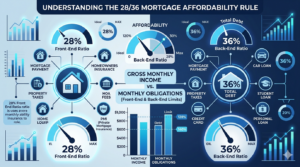
The rule works like this: no more than 28% of your gross monthly income should go toward housing costs, and no more than 36% should go toward all debt combined. These two thresholds — called the front-end ratio and back-end ratio — are the backbone of mortgage underwriting guidelines used by lenders across the United States.
Understanding the 28/36 rule explained for home buyers helps you set realistic expectations before you apply, avoid financial stress after you buy, and negotiate your loan from a position of knowledge. This guide covers exactly what the rule means, how to calculate both ratios, where exceptions exist, and how to apply it to your own financial situation.
What Is the 28/36 Rule?
The rule has two distinct components:
- The 28% front-end limit (also called the housing expense ratio or household expense ratio) covers principal, interest, property taxes, and homeowner’s insurance — sometimes abbreviated as PITI.
- The 36% back-end limit (also called the total debt ratio) covers PITI plus all other recurring monthly debt payments, including car loans, student loans, credit cards, and personal loans.
These percentages are not laws they are affordability benchmarks grounded in decades of mortgage underwriting guidelines and risk mitigation research. Lenders including Rocket Mortgage, Chase Bank, and U.S. Bank use variations of these thresholds in their qualification processes, though actual limits vary by loan type and lender.
How the 28/36 Rule Works in Practice
The 28% Front-End Ratio: Housing Expense Threshold
The front-end ratio measures only your housing costs against your income. It answers the question: what percentage of your gross monthly income would go toward your monthly mortgage payment?
Housing costs counted in this ratio typically include:
- Mortgage principal and interest (P&I)
- Property taxes (monthly escrow portion)
- Homeowner’s insurance (monthly escrow portion)
- HOA fees (if applicable)
- Private mortgage insurance or PMI (if applicable)
Formula: Front-End Ratio = Monthly Housing Costs / Gross Monthly Income x 100
Example: If your gross monthly income is $5,500 and your estimated PITI is $1,400, your front-end ratio is 1,400 / 5,500 x 100 = 25.5%. This falls comfortably within the 28% threshold.
The 36% Back-End Ratio: Total Debt Load Management
The back-end ratio takes a wider view. It includes your housing payment plus every other recurring monthly debt obligation. This is the number lenders scrutinize most closely because it reflects your true debt load management burden.
Debts included in the back-end ratio:
- All housing costs (same as front-end)
- Auto loan payments
- Student loan payments (minimum or calculated payment)
- Credit card minimum payments
- Personal loan installments
- Any other installment or revolving debt with a monthly obligation
Formula: Back-End Ratio = (Monthly Housing Costs + All Monthly Debts) / Gross Monthly Income x 100
Example: Using the same $5,500 income, if you have $400 in car payments, $200 in student loans, and $100 in credit card minimums — your existing debt is $700/month. Adding the $1,400 PITI: $2,100 / $5,500 x 100 = 38.2%. This exceeds the 36% guideline, signaling that debt reduction before applying may be beneficial.
Why Lenders Use the 28/36 Rule
Lenders use this rule as part of their underwriting process to assess repayment ability and creditworthiness. Research from institutions including the Federal Reserve and academic studies cited by the Consumer Financial Protection Bureau (CFPB) supports the idea that borrowers with housing ratios above 28-30% face higher rates of mortgage delinquency.
The rule also aligns with Qualified Mortgage (QM) standards established by the CFPB under the Ability-to-Repay framework, which requires lenders to verify that borrowers can reasonably afford the loans they originate.
How to Apply the 28/36 Rule: Step by Step
Follow these steps to calculate your own front-end and back-end ratios and determine where you stand relative to the 28/36 guideline.
- Calculate Your Gross Monthly Income — Use your pre-tax monthly income. If salaried, divide your annual salary by 12. If self-employed, average your last two years of net profit. Include only stable, verifiable income sources.
- Estimate Your Monthly Housing Costs (PITI) Get a mortgage payment estimate based on the loan amount, interest rate, and term you are considering. Add estimated monthly property taxes and homeowner’s insurance. Include PMI if your down payment is less than 20%.
- Calculate Your Front-End Ratio — Divide your estimated monthly PITI by your gross monthly income and multiply by 100. If the result is 28% or below, you meet the front-end guideline.
- List All Existing Monthly Debt Payments — Write down every recurring monthly debt obligation: car loans, student loans, minimum credit card payments, personal loans, and any other installment obligations.
- Add Housing and Debt Payments Together — Sum your estimated PITI and all existing monthly debts to get your total monthly obligations.
- Calculate Your Back-End Ratio — Divide total monthly obligations by your gross monthly income and multiply by 100. If the result is 36% or below, you meet the back-end guideline.
- Evaluate Your Results — If both ratios are within guidelines, you are in a strong position to apply. If either exceeds the threshold, identify whether paying down debt or increasing income would bring you into range.
- Factor in Compensating Factors — If your ratios exceed the guidelines, consider whether you have strong compensating factors: high credit score (FICO 740+), significant cash reserves, large down payment, or stable long-term employment. These may allow lenders to approve ratios above the standard limits.
- Compare Loan Programs — Different loan types have different official DTI limits. Compare conventional, FHA, VA, and USDA programs to find which fits your ratios best before applying.
How Lenders Apply the 28/36 Rule: Variations by Loan Type
The 28/36 rule is a general guideline, not a universal hard requirement. Different loan programs apply different debt-to-income ratio limits, and lenders often have internal overlays that differ from program minimums.
Conventional Loans: Fannie Mae and Freddie Mac
Conventional loans following Fannie Mae and Freddie Mac guidelines do not enforce a strict 28% front-end cap. The primary focus is on the back-end (total) DTI, which Fannie Mae’s Desktop Underwriter (DU) allows up to 45% for manually reviewed loans and up to 50% in some automated scenarios with strong credit profiles.
The 28% front-end ratio remains a practical benchmark that most conventional lenders reference, but borrowers with excellent FICO scores and substantial reserves may be approved with higher housing ratios.
FHA Loans: Federal Housing Administration
The Federal Housing Administration sets official DTI guidelines for FHA loans: a front-end limit of 31% and a back-end limit of 43% as standard. Borrowers with compensating factors — such as a FICO score of 580 or higher, additional cash reserves, or a history of low housing expense — may be approved with back-end DTI up to 57% in some cases.
FHA loans are designed for borrowers with moderate income and lower credit scores. They allow more flexibility on debt ratios than the classic 28/36 guideline, making them accessible to a wider range of home buyers.
VA Loans: Department of Veterans Affairs
VA loans, available to eligible veterans and active-duty service members, do not use a traditional front-end/back-end DTI structure. Instead, VA lenders evaluate residual income — the net income remaining after all obligations are paid. The VA does note a 41% back-end DTI as a soft benchmark, but residual income takes priority in underwriting decisions.
USDA Loans
USDA Rural Development loans use a 29% front-end limit and 41% back-end limit as standard guidelines, though exceptions are possible with compensating factors. USDA loans also require that total household income does not exceed 115% of the area median income.
28/36 Rule vs. Lender DTI Limits by Loan Program
The table below compares the classic 28/36 guideline against the official DTI limits of major loan programs used by US home buyers.
| Loan Program | Front-End (Housing) Limit | Back-End (Total Debt) Limit | Exceptions Allowed? | Governing Body |
| 28/36 Rule (Classic) | 28% | 36% | Based on lender discretion | Industry standard / lenders |
| Conventional (Standard) | No firm limit (28% typical) | 45% (up to 50% with AUS) | Yes — strong credit/reserves | Fannie Mae / Freddie Mac |
| FHA Loan | 31% | 43% standard (up to 57%) | Yes — compensating factors | Federal Housing Administration |
| VA Loan | N/A (residual income used) | 41% soft benchmark | Yes — residual income focus | Dept. of Veterans Affairs |
| USDA Loan | 29% | 41% | Yes — compensating factors | USDA Rural Development |
| Jumbo Loan | Varies by lender | 43% or lower typical | Limited — stricter overlays | Private lenders |
Real-World Examples of the 28/36 Rule
Example 1: Borrower Within Both Guidelines
Annual salary: $72,000 | Gross monthly income: $6,000
Estimated PITI: $1,560 | Front-end ratio: 1,560 / 6,000 = 26% (within 28%)
Existing debts: $500/month (car + student loan)
Back-end: (1,560 + 500) / 6,000 = 34.3% (within 36%)
Example 2: Borrower Exceeding Back-End Only
Annual salary: $60,000 | Gross monthly income: $5,000
Estimated PITI: $1,300 | Front-end ratio: 26% (within 28%)
Existing debts: $900/month (two car loans, credit cards)
Back-end: (1,300 + 900) / 5,000 = 44% (exceeds 36%)
Result: Front-end is fine but back-end exceeds the classic guideline. This borrower might still qualify under FHA (up to 43-57% DTI) or conventional programs with strong compensating factors. Paying off one car loan would significantly reduce the back-end ratio.
Example 3: Dual-Income Household
Combined annual salary: $110,000 | Gross monthly income: $9,167
Estimated PITI: $2,400 | Front-end ratio: 26.2% (within 28%)
Existing debts: $1,100/month
Back-end: (2,400 + 1,100) / 9,167 = 38.2% (slightly over 36%)
Result: Slightly over the 36% back-end guideline but well within Fannie Mae’s 45% cap. A conventional loan is still achievable. The couple might reduce debt by $200/month to bring back-end under 36% and optimize their rate.
How Your FICO Score and Creditworthiness Interact with the 28/36 Rule
The 28/36 rule operates alongside your credit score — not independently of it. A high FICO score can compensate for ratios that slightly exceed guidelines; a low FICO score can make lenders enforce stricter thresholds even when ratios look healthy.
According to FICO, your score reflects your repayment ability based on payment history (35%), amounts owed (30%), length of credit history (15%), new credit (10%), and credit mix (10%). Lenders such as Chase Bank and Rocket Mortgage factor your FICO score into risk pricing and approval decisions alongside DTI.
General interaction:
- FICO 740+: Lenders may approve higher DTI ratios with ease. Compensating factors carry more weight.
- FICO 680-739: Standard DTI guidelines typically apply. Ratios above 36% back-end will receive closer scrutiny.
- FICO 620-679: Lenders may enforce tighter DTI limits, even if the loan program officially allows higher ratios.
- FICO below 620: Conventional loan approval becomes difficult regardless of DTI. FHA may still be accessible.
Common Mistakes Home Buyers Make with the 28/36 Rule
- Using Take-Home Pay Instead of Gross Income: The 28/36 rule is based on gross (pre-tax) monthly income. Using your after-tax take-home pay will produce a higher, inaccurate ratio. Always use your gross income in the calculation.
- Forgetting to Include All Housing Costs in the Front-End Ratio: Many buyers estimate only principal and interest. Forgetting property taxes, homeowner’s insurance, HOA dues, and PMI leads to underestimating the front-end ratio. Add all components of PITI before calculating.
- Ignoring Small Monthly Debts: Minimum credit card payments, subscriptions with payment plans, and other small recurring debts all count toward the back-end ratio. Omitting even $200-$300 in monthly obligations can cause surprises during lender underwriting.
- Assuming 28/36 Guarantees Approval: Meeting the 28/36 guideline does not guarantee mortgage approval. Lenders also evaluate credit score, employment history, asset reserves, property appraisal, and other factors. The rule is a starting benchmark, not a pass/fail test.
- Applying the Rule to Net Income from Self-Employment: Self-employed borrowers often calculate their income based on bank deposits rather than IRS-reported net income. Lenders use tax return net profit — which is frequently lower than gross deposits — when calculating DTI ratios.
- Not Accounting for Rate Changes: Your PITI estimate is tied to a specific interest rate. If rates rise between pre-qualification and closing, your front-end ratio increases. Build a buffer into your calculations and avoid maxing out the 28% limit based on a rate that may not hold.
- Overlooking the Back-End Ratio When Focused on Home Price: Many first-time buyers focus exclusively on the purchase price and front-end payment. The back-end ratio is the number that most often causes loan denial. Evaluate your full debt picture before falling in love with a home price.
Final Conclusion
The 28/36 rule explained for home buyers is one of the most useful frameworks in personal finance and mortgage planning. It gives you two clear benchmarks — 28% for housing costs and 36% for total debt — that reflect decades of underwriting guidelines and risk mitigation research used by lenders across the country.
Meeting these thresholds does not guarantee a mortgage, and exceeding them does not guarantee denial. Loan programs from the Federal Housing Administration (FHA), Fannie Mae, Freddie Mac, and the Department of Veterans Affairs all have their own official DTI limits that may be more flexible than the classic rule. Your FICO score, down payment, employment history, and cash reserves all interact with your ratios in the underwriting process.
The most valuable way to use the 28/36 rule is as a planning tool: before you begin house hunting, before you approach lenders like Rocket Mortgage or Chase Bank, and before you fall in love with a purchase price. Calculate both your front-end and back-end ratios honestly, using gross income, and identify exactly where you stand.
If your ratios need work, the path is clear: reduce debt, grow income, or both. The Consumer Financial Protection Bureau’s free educational tools and HUD-approved housing counselors can help you build a realistic plan. Homeownership is achievable — knowing your numbers makes it far more likely.